What Is Digital Marketing
What Is Digital Marketing? A Complete Guide to Online Marketing in 2026
Type “what is digital marketing” into Google and you’ll get hundreds of millions of results in under a second — a little ironic, since search itself is one of the biggest pieces of digital marketing there is. Maybe you’ve heard terms like SEO, PPC, or content marketing thrown around and never quite pinned down what they mean. Or maybe you’re just trying to figure out how a coffee shop with forty Instagram followers turned into a regional chain. Either way, this guide is for you.
Here’s what we’ll cover: what digital marketing actually is, why it matters in 2026, the main types and channels businesses lean on, how it stacks up against traditional marketing, and how to build a strategy that doesn’t just sit in a folder collecting dust. Whether you’re a business owner, a student, or someone eyeing a career switch, you’ll walk away with a working understanding of digital marketing — not just the buzzwords.
What Is Digital Marketing?
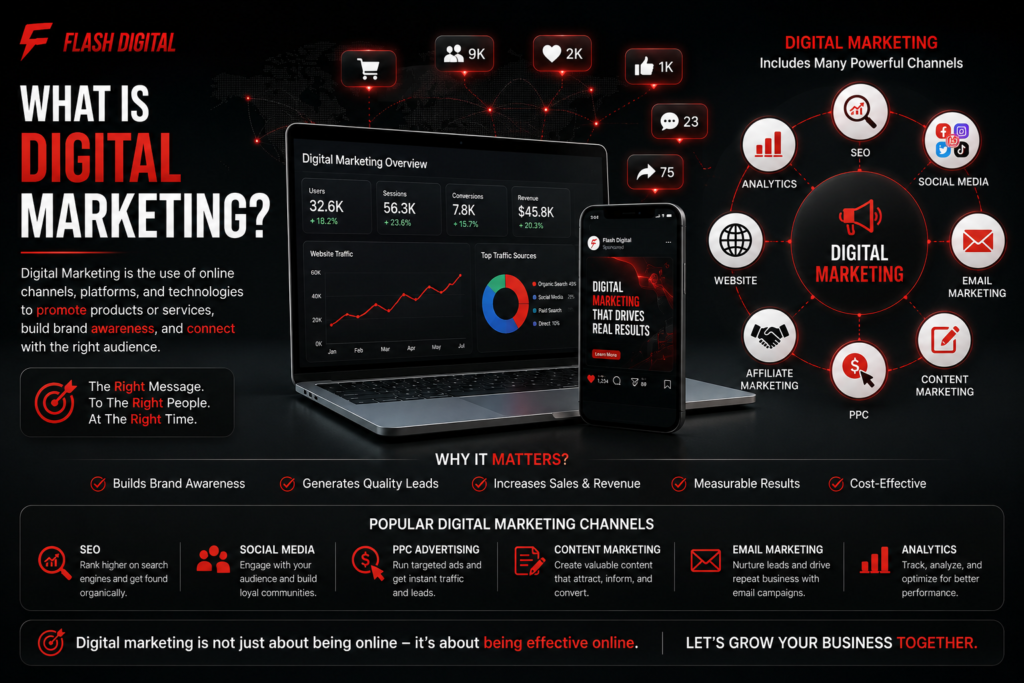
Digital marketing is the practice of promoting products, services, or brands through digital channels — search engines, social media, email, websites, mobile apps, and paid ads — instead of, or alongside, traditional channels like print, TV, and billboards. At its core, it’s still marketing: understanding what people need and putting your brand in front of them at the right moment. What’s changed is where that moment happens.
Picture someone scrolling Instagram at nine at night who stumbles on an ad for a skincare brand she’s never heard of. She taps it, lands on a product page, skims a couple of reviews, and checks out before she’s even finished her tea. The ad, the landing page, the reviews, the checkout — all of it is digital marketing at work. A billboard on the highway chases the same goal through completely different mechanics, and it has no way of telling you who looked twice, who scrolled past, or why.
Why Digital Marketing Matters
Here’s a number that tends to catch people off guard: over 6 billion people are online worldwide now — close to three-quarters of the planet’s population. That’s not a niche audience; it’s most of your potential customers, sitting in one connected space. Global ad spend is on track to cross $1 trillion in 2026, with roughly 69% of that flowing into digital channels rather than print or TV. Money follows attention, and attention has moved online.
For a business, that shift is very practical. Customers are already searching, scrolling, and comparing options before they ever walk into a store or pick up the phone. If you’re not visible in that moment — on Google, in their feed, in their inbox — a competitor probably is. That’s the real importance of digital marketing today: it’s not a bonus channel anymore. For most industries, it’s the primary one.
How Digital Marketing Works
Digital marketing works by meeting people at different points along what’s usually called the buyer’s journey: awareness, consideration, and decision.
In the awareness stage, the person doesn’t know your brand exists yet. SEO content, social posts, and display ads earn their keep here, putting your name in front of someone who’s just starting to realize they have a problem worth solving.
By consideration, they know you exist and are weighing you against two or three other options. This is usually where email marketing, retargeting ads, case studies, and reviews carry the most weight.
Then comes decision — they’re ready to buy, and this is where PPC ads, a clean website, clear pricing, and a frictionless checkout either close the sale or lose it. A slow-loading page at exactly this moment can cost a business a sale it spent weeks earning.
Behind all of this sits data. Every click, scroll, and abandoned cart gets tracked through tools like Google Analytics, Meta Ads Manager, or a CRM, which is what lets marketers see what’s actually working and shift budget away from what isn’t. Traditional marketing never really offered that kind of visibility.
Main Types of Digital Marketing
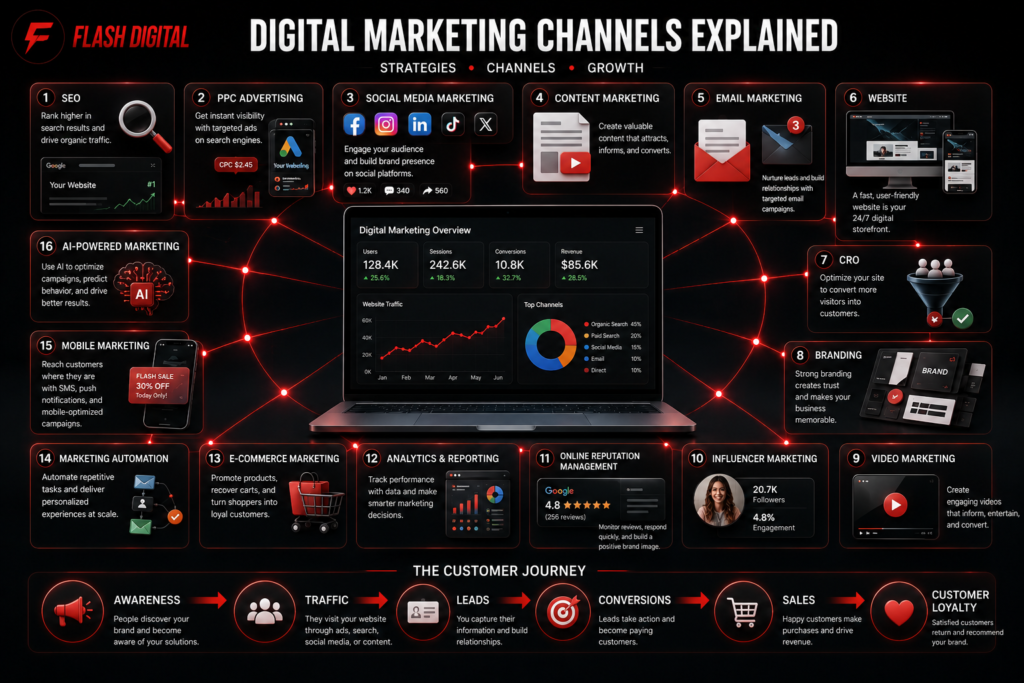
There isn’t one way to “do” digital marketing — it’s a toolbox of channels, and most successful strategies combine several. Here’s a rundown of the ones that matter most right now.
Search Engine Optimization (SEO) is the slow-and-steady member of the group. It’s the process of optimizing a website so it ranks higher in unpaid, organic search results, blending technical fixes (site speed, mobile-friendliness) with content that actually answers what people are searching for, backed by links that vouch for your site’s credibility. It usually takes four to six months before you see real movement, but unlike paid traffic, it doesn’t vanish the moment you stop spending.
If SEO is the long game, Pay-Per-Click Advertising (PPC) is the fast one. You’re charged only when someone clicks your ad — most commonly on Google Search, YouTube, or Bing — and a well-run campaign can put a brand-new business at the top of search results within a day. The catch is cost: average search-ad prices in competitive markets often run $2 to $3 per click in the US, and loose targeting can burn through a budget fast.
Social media marketing covers everything from organic posts on Instagram and TikTok to paid campaigns on Facebook and LinkedIn. It’s less about broadcasting and more about showing up consistently where your audience already spends time. A bakery posting behind-the-scenes reels, for instance, tends to build more trust than one running polished ads nobody asked for.
Then there’s content marketing — creating genuinely useful material like blog posts, videos, guides, and podcasts that pulls people in rather than interrupting them. Do it well, and it builds the kind of trust that gets someone to choose your brand months later, even if they first found you through a completely unrelated blog post.
Don’t underestimate email marketing, still one of the highest-ROI channels around, largely because you own your list. Unlike a social platform’s algorithm, which can change overnight without warning, your email list is yours to keep. A well-segmented welcome sequence or abandoned-cart email routinely beats a generic newsletter blast.
Your website deserves its own mention too, since it’s the one digital asset you fully control and often the last stop before someone decides to buy. A cluttered, slow site can quietly undo the work of every other channel that sent traffic to it.
Closely related is conversion rate optimization (CRO) — tweaking a website or landing page (button colors, headline wording, form length) to turn more visitors into customers without spending an extra dollar on traffic. Sometimes the fix is as small as removing two unnecessary form fields.
Underneath all of these channels sits branding and creative: the visual and emotional identity behind everything else — logo, tone of voice, color palette, the overall “feel” of a brand. Strong branding is what makes an ad recognizable even with the logo covered.
Video marketing has quietly become one of the most powerful formats out there, whether it’s a YouTube tutorial or a fifteen-second clip, mostly because video communicates faster than text and builds familiarity quicker too.
Some brands get more mileage out of influencer marketing — partnering with creators who already have an audience’s trust. Sometimes that’s a major celebrity, but more often it’s a niche creator with twenty thousand highly engaged followers, which frequently converts better than a much bigger but less relevant audience.
Online reputation management is the ongoing, less glamorous work of monitoring and shaping how a brand is perceived online: responding to reviews, managing a Google Business Profile, addressing complaints before they spiral. A single unanswered one-star review can cost more trust than ten glowing ones can rebuild.
None of this means much without analytics and reporting — the behind-the-scenes discipline of measuring click-through rates, bounce rates, and cost per acquisition so decisions are based on data instead of guesswork.
Online stores lean heavily on e-commerce marketing: product listing ads, abandoned-cart flows, marketplace optimization on platforms like Amazon, and post-purchase email sequences that turn a one-time buyer into a repeat customer.
Marketing automation software handles the repetitive tasks — sending a birthday discount, tagging a lead who downloaded a guide — so a small team can operate like a much bigger one.
With phones now dominating web traffic in many markets, mobile marketing — SMS campaigns, app push notifications, mobile-optimized ads — has moved from optional to essential.
And rounding things out is the newest addition to the toolbox: AI-powered marketing. This covers using AI to generate ad creative, predict which customers are about to churn, personalize website content in real time, or automatically optimize ad bidding. Early data suggests AI-assisted campaigns are already outperforming manually managed ones on return per dollar spent.
FAQs
Pretty much — the terms get used interchangeably, though digital marketing technically also covers things like SMS and digital displays that aren’t strictly “online.”
SEO earns free traffic over time through content and optimization. PPC buys traffic instantly, but it stops the moment you stop paying.
Yes — a sharply targeted campaign with a few hundred dollars a month can outperform a broad budget, because it reaches the right 200 people instead of the wrong 20,000.
Traditional Marketing vs Digital Marketing
For most of the twentieth century, marketing meant print ads, radio spots, TV commercials, and billboards — one-way messages sent to a broad audience with no real way to know who saw them or whether any of it worked. Digital marketing flipped that model on its head. Instead of guessing, marketers can now see, almost in real time, who clicked, who bought, and who dropped off halfway through checkout.
That doesn’t make traditional marketing obsolete. A well-placed TV spot during a major cricket match can still reach millions at once, and plenty of local businesses still get solid results from a flyer or a radio mention. But when it comes to targeting, cost flexibility, and measurability, the two simply aren’t in the same league.
Benefits of Digital Marketing
Cost is usually the first thing people notice — a small business can launch a Facebook ad campaign with as little as $5–$10 a day, something a TV spot never allows. Targeting is just as important: an ad can be shown only to, say, women aged 25–34 in a specific city who’ve shown interest in skincare, rather than an entire population.
Then there’s measurability. Every dollar spent can be traced to a click, a lead, or a sale, so budget naturally shifts toward what’s actually working. Customers, meanwhile, get a two-way relationship instead of a one-way broadcast — they can comment, ask questions, and get public answers, which builds a kind of trust static ads just can’t match.
Geography stops being a limitation too, since a shop in one city can sell to a customer on another continent without ever opening a second location. And when something isn’t working, digital marketing lets you know fast — a poorly performing ad can be paused or rewritten in minutes, not after a month-long print run is already out the door.
Challenges of Digital Marketing
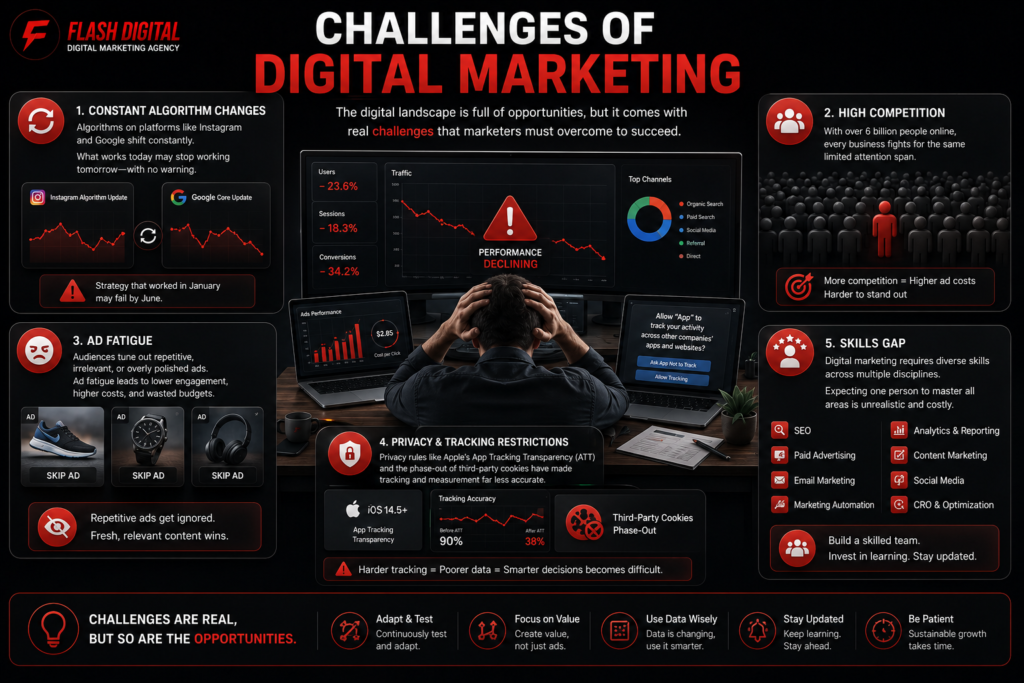
It isn’t all smooth sailing. Algorithms on platforms like Instagram and Google shift constantly, and a strategy that worked brilliantly in January can quietly stop working by June with no explanation given. Competition is fierce too — with over 6 billion people online, every other business is fighting for the same limited attention span.
Ad fatigue is a real problem: audiences tune out repetitive or overly polished ads fast. Privacy rules have made things harder as well. Apple’s App Tracking Transparency update is a good example — once it rolled out, many Facebook advertisers found their conversion tracking suddenly far less accurate, since a large share of iPhone users simply opted out of being tracked across apps. That single policy change forced marketers across the industry to rethink how they measured ad performance, and it’s part of why third-party cookies are being phased out more broadly now too.
On top of that, there’s a genuine skills gap. SEO, paid ads, email automation, and analytics are different disciplines, and expecting one person to master all of them overnight is a common, costly mistake for growing businesses.
FAQs
Most established small businesses spend around 7–10% of revenue; brand-new businesses often spend closer to 12–15% to build initial visibility.
PPC can show results within days. SEO and content marketing usually need four to six months before real momentum kicks in.
No — it’s better to master one or two platforms where your actual customers spend time than to spread thin across five.
How to Create a Digital Marketing Strategy
Building a strategy doesn’t have to be complicated, but skipping steps usually shows up later as wasted ad spend.
- Define your goal. “Get more customers” isn’t a goal — “generate 50 qualified leads a month” is. Get specific before spending anything.
- Know your audience. Sketch a rough profile: age range, location, the problem they’re trying to solve, where they spend time online.
- Pick your channels. A B2B software company probably needs LinkedIn and email more than TikTok; a clothing brand is often the opposite.
- Set a realistic budget. Most small businesses start around 7–10% of revenue and adjust once they see what converts.
- Create the content and campaigns. This is where SEO pages, ads, and social content actually get built and published.
- Track and optimize weekly, not just at quarter’s end — small, early adjustments save the most money over time.
This is often the exact point where business owners get stuck and start typing “digital marketing agency near me” into Google — not because the theory is hard to learn, but because running six channels well, on top of running the actual business, is a lot to carry alone. There’s no shame in that; even large companies outsource pieces of this work.
Future of Digital Marketing
AI is arguably the biggest shift happening in digital marketing right now. AI-generated overviews already show up on a significant share of Google searches, changing how people find information and how often they click through to a website at all. Voice search, AI-assisted ad creative, hyper-personalized email content, and automated bid management are moving from “nice to have” to standard practice.
At the same time, privacy is tightening. Cookie-based tracking is fading, and first-party data — your own email list, your own customer history — is becoming the asset that matters most. Video, especially short-form, isn’t slowing down either, and retail media (ads placed inside platforms like Amazon) has become one of the fastest-growing channels, a category that barely existed a few years back.
None of this makes the fundamentals obsolete, though. Understanding your audience, creating something genuinely useful, and measuring what works will matter just as much years from now — it’s just the tools around those fundamentals that keep getting sharper.
Conclusion
Digital marketing isn’t a single tactic — it’s the whole ecosystem of SEO, PPC, social media, content, email, and everything else that helps a business get found, get trusted, and get chosen. Whether you’re running a two-person startup or managing marketing for an established company, the businesses that treat digital marketing as ongoing, measurable work, rather than a one-time project, are the ones that keep growing.
Start with one or two channels, get genuinely good at them, and build outward from there. That’s a far more reliable strategy than trying to be everywhere at once.
Related Questions
- What is SEO and how does it work?
- What is PPC advertising and how is it priced?
- How does social media marketing help small businesses grow?
- What is conversion rate optimization (CRO)?
- How much does digital marketing cost for a small business?
- How does marketing automation save time for small teams?
- What is the difference between B2B and B2C digital marketing?
- What does a complete digital marketing strategy include?