
Is Search Engine Optimization Worth It?

Is Search Engine Optimization Worth It? Everything You Need to Know
What “Is Search Engine Optimization Worth It” Really Means
If you’ve ever sat in a marketing meeting and heard someone ask, “is search engine optimization worth it,” you already know the room usually splits into two camps. One side swears by it. The other has been burned by an agency that promised the moon and delivered a keyword spreadsheet. Both reactions make sense, because SEO isn’t magic — it’s a slow, compounding investment, and how it’s executed matters just as much as whether you do it at all.
Here’s the short version: search engine optimization is worth it for the vast majority of businesses that plan to stick around for more than a year. Paid ads stop the moment you stop paying. SEO, once it’s built, keeps working in the background — a blog post from 2023 can still be pulling in leads today without another dollar spent on it. That’s the core appeal, and it’s why organic search traffic remains one of the highest-ROI channels in digital marketing when it’s done with any real discipline.
The confusion usually comes from mixing up two very different things: SEO as a marketing tactic and SEO as a business investment. As a tactic, it’s technical — meta titles, site speed, backlinks. As an investment, it behaves more like buying a piece of real estate in a good part of town. You pay upfront in time and effort, the value doesn’t show up immediately, but the longer you hold onto it, the more it’s worth relative to what you put in.
Is Your Industry a Good Fit for SEO?
Not every business gets the same payoff at the same speed. A local service business — plumbing, dentistry, landscaping — usually sees faster wins because local search has less national competition to fight through. A national e-commerce brand competing for a term like “running shoes” is up against retail giants with years of backlinks and content already built, so the timeline stretches out and the strategy has to be sharper: long-tail product terms, category-page optimization, and reviews, rather than chasing the single big keyword head-on.
That said, we’ve rarely seen an industry where SEO simply doesn’t work. Even niche B2B companies selling industrial equipment get real value from it, just through a smaller, more specific set of keywords with far less competition — which often means a faster path to page one than a crowded consumer market would allow.
The Real ROI Numbers Behind SEO
Take a mid-sized HVAC company we’ve worked with in the past: they went from roughly 400 monthly organic sessions to over 3,800 in fourteen months, with zero increase in ad spend. That’s not an outlier story pulled from a case-study brochure — it’s the normal shape of an SEO campaign that combines solid technical SEO, useful content, and a handful of quality backlinks. The traffic doesn’t arrive overnight, but once it arrives, it tends to stay.
Numbers like these are what “what is the return on investment of SEO” actually looks like in practice. It’s rarely about a single month’s performance — it’s the cumulative effect. A service page that ranks in position three for a decent-volume keyword can keep producing five, ten, even twenty leads a month for years, long after the invoice for building it has been paid and forgotten. Compare that to a paid campaign generating the same twenty leads: the moment the budget stops, so does the traffic.
A useful way to think about it: if a single ranking page costs $1,500 to research, write, and optimize, and it generates even three qualified leads a month at a modest $200 average customer value, that page has paid for itself within three months — and every month after that is close to pure return. Multiply that across a dozen ranking pages built over a year, and the math is what makes SEO investment attractive to finance-minded business owners, not just marketers.

Why Organic Traffic Converts Better Than Paid Traffic
The benefits of SEO go beyond just “more visitors.” People who find you through Google are already searching for what you sell, which means the traffic converts at a higher rate than most cold outreach or display advertising ever will. A visitor who typed “emergency plumber” into Google at 11 p.m. isn’t browsing — they’re buying. That intent is the entire reason SEO marketing strategy work is treated as a growth lever and not just a branding exercise.
None of this means SEO is free or instant. It takes real work: keyword research to figure out what your customers are actually typing into the search bar, on-page SEO to structure your pages so Google — and readers — understand them, and enough patience to let Google’s crawlers catch up with your changes. Most businesses start seeing measurable movement in search engine rankings somewhere between month three and month six, with the bigger payoff — page-one rankings for competitive terms — often taking six to twelve months. If someone promises you first-page rankings in two weeks, that’s a red flag, not a selling point.
Frequently Asked Questions
Ongoing. Search engines update constantly, and competitors keep publishing, so SEO needs regular upkeep to hold its rankings.
Most sites see early movement in 3–4 months, with stronger, more stable rankings by month six to twelve.
Yes — small businesses often see the fastest relative gains because local competition is lighter than in national markets.
SEO vs. Paid Advertising: Which One Actually Wins?
A lot of the “SEO vs paid advertising which is better” debate is really a false choice. Paid search is great for instant visibility — you launch a campaign on Monday and you’re on page one by Monday afternoon. But the cost per click adds up fast, especially in competitive industries like legal services or home insurance, where a single click can run $40 or more. Turn off the budget, and that traffic disappears the same day.
SEO investment works differently. You’re not renting space at the top of the results page; you’re building an asset. A well-optimized service page, once it earns a solid position, keeps generating leads for years with only light maintenance. We’ve seen individual blog posts that took eight hours to write and edit go on to generate six figures in attributed revenue over three years — a return that no paid campaign with the same upfront cost could realistically match.
The smartest businesses we work with don’t actually pick one over the other. They run paid ads for immediate revenue while SEO builds in the background, then gradually shift budget away from ads as organic rankings mature and start carrying more of the load. It’s less “SEO versus PPC” and more a relay race, where paid search covers the early miles while organic picks up the pace later on.
Technical SEO: The Foundation
Technical SEO makes sure Google can actually crawl and index your site in the first place — fast load times, mobile-friendly design, clean site architecture, and no broken links dragging down the experience. Skip this step, and even the best-written content on the internet won’t rank, because search engines simply can’t read or trust the site it’s sitting on.
On-Page SEO and Content: Matching Search Intent
Content marketing ties everything together by answering the actual questions your customers are asking, which is what search intent is fundamentally about — matching a page to the reason someone typed that query in the first place. On-page SEO is the structural half of this: clear headings, descriptive titles, and internal links that guide both readers and search engines through the rest of your site.

Off-Page SEO and Domain Authority
Off-page SEO, mainly link building and reputation signals, builds the domain authority that helps you compete against bigger, more established sites. A single mention from a respected industry publication can do more for your rankings than a hundred low-quality directory listings — quality has consistently mattered more than volume here.
Common SEO Mistakes That Waste the Investment
A surprising amount of wasted SEO budget doesn’t come from bad strategy — it comes from avoidable mistakes. Duplicate content across near-identical service pages confuses Google about which page to rank, so instead of one strong page, you end up with three weak ones competing against each other. Keyword stuffing, still shockingly common, tends to trigger the opposite of the intended effect once Google’s spam-detection systems flag the pattern.
Ignoring mobile performance is another costly one. More than 60% of searches now happen on a phone, and Google indexes the mobile version of a site first, not the desktop version — so a beautiful desktop site with a clunky mobile experience is quietly losing rankings it doesn’t even realize it’s losing. And perhaps the most common mistake of all: giving up around month three, right before the compounding effect actually kicks in.
SEO for E-Commerce vs. Local Service Businesses
The playbook shifts depending on what you’re selling. E-commerce SEO leans heavily on product and category page optimization, structured data so Google can show star ratings and prices directly in search results, and building content around comparison and “best of” style searches where buyers are still deciding what to purchase. Local service businesses — HVAC companies, law firms, dental practices — lean much harder on Google Business Profile optimization, review generation, and location-specific landing pages for each city or neighborhood they serve.
Both approaches share the same underlying principles — technical health, useful content, credible links — but the day-to-day priorities look different enough that a strategy built for one rarely transfers cleanly to the other without real adjustment.
Turning Rankings Into Leads and Conversions
User experience plays a bigger role than people expect, too. Google’s ranking systems reward pages that people actually stay on and engage with, so a site with confusing navigation or a five-second load time will struggle no matter how good the content is. Better UX usually means better website conversions as well — visitors who can find what they need without frustration are simply more likely to fill out a form or pick up the phone. And once you’re generating consistent search visibility, the lead generation side tends to take care of itself, because you’re showing up right when someone’s already looking for a solution.
Tracking What Matters: SEO Analytics
It also helps to track the right numbers. SEO analytics — organic sessions, keyword position changes, conversion rate by landing page — turn what feels like guesswork into something you can actually manage month over month. Businesses that treat SEO analytics as a monthly habit, not an annual report, tend to catch problems, like a dip in rankings or a technical error after a site update, months before they’d otherwise notice lost revenue.
Frequently Asked Questions
It puts your business in front of people actively searching for your product or service, which converts far better than passive advertising.
For most businesses without in-house expertise, yes — an experienced agency avoids costly technical mistakes and shortens the learning curve.
Yes, consistently — most businesses see steady, compounding traffic growth once core pages start ranking for relevant search terms.
Is SEO Still Worth It in 2026?
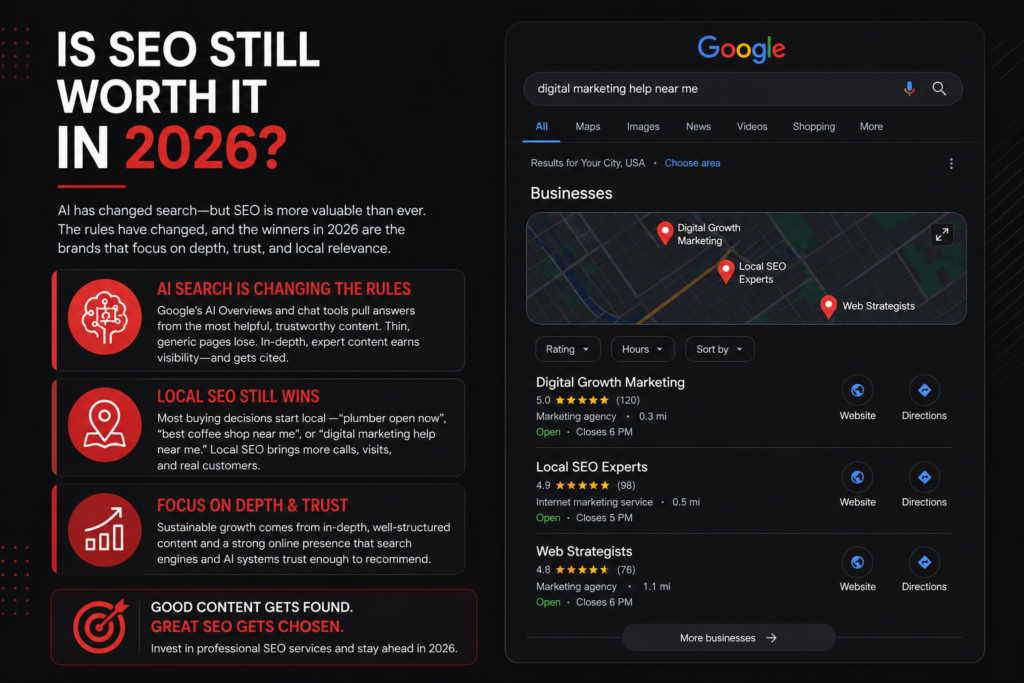
Given how much AI has changed search over the past couple of years, it’s a fair question. Google’s search results now include AI overviews, and more people are asking questions directly inside chat tools. So is search engine optimization worth it in 2026? If anything, it’s become more important, not less — because ranking well now means being the source that AI systems and search engines both trust enough to cite. Sites with thin, generic content are the ones losing ground; sites with genuinely useful, well-structured pages are picking up the traffic they leave behind.
How AI Search Is Changing the Rules
Sustainable traffic growth in this environment comes down to depth and trust more than keyword density. Google’s algorithms have gotten much better at recognizing content written by people who actually know the subject versus content stitched together to rank. That’s good news for legitimate businesses — the bar for “good enough to win” content has gone up, which pushes out low-effort competitors and rewards companies willing to invest properly in professional SEO services.
Local SEO Still Wins the Everyday Searches
Not every search is about winning a national keyword war. A huge share of buying decisions start with something local — “plumber open now,” “best coffee shop downtown,” or a business owner typing digital marketing help near me while looking for someone to actually call. Local SEO — an optimized Google Business Profile, consistent name, address, and phone details across directories, and location-specific landing pages — is often the fastest, most affordable way for a small or mid-sized business to see real movement in leads.
What a Realistic SEO Budget Looks Like
One of the most common questions after “is it worth it” is “what does it actually cost.” For a small local business, a reasonable starting budget usually falls somewhere between $750 and $2,000 a month, covering content, basic technical fixes, and local optimization. Mid-sized companies chasing more competitive regional or national terms often invest $2,500 to $7,500 a month, with larger e-commerce or enterprise sites going higher still, given the sheer number of pages and the level of competition involved.
The number that matters more than the sticker price is cost per acquired customer over time. A $2,000-a-month SEO retainer that produces fifteen qualified leads a month, at even a modest close rate, often ends up cheaper per customer than the equivalent paid ad spend within the first year — and considerably cheaper in year two, once the content built in year one is still ranking without additional cost.
Signs Your Current SEO Strategy Isn’t Working
It’s worth being honest about the warning signs, too. Flat or declining organic traffic over three consecutive months, rankings that move but never quite crack the first page, or a site that’s technically “optimized” but hasn’t published new content in over a year are all signals that something in the strategy needs to change, not that SEO itself has failed. Just as often, the fix isn’t a bigger budget — it’s redirecting the existing budget toward the specific gaps, whether that’s a technical audit, a content refresh, or finally addressing a mobile experience that’s been quietly holding rankings back.
SEO Investment vs. Hiring an Agency
At Flash Digital, based in Silicon Valley, CA, we’ve built our process around exactly this mix: strong technical foundations, content built around real search intent, and local optimization for businesses that live and die by their surrounding community. Companies come to us after trying to handle SEO in-house for a year with little to show for it, and the difference usually isn’t effort — it’s knowing which of the dozens of possible SEO tasks actually move the needle for their specific industry and location.
That’s really the calculation behind “is hiring an SEO agency worth the investment.” Doing SEO badly for a year can waste more money in staff time than hiring it out properly would have cost, simply because so many of the mistakes — duplicate content, broken redirects, keyword cannibalization — are invisible until someone experienced points them out. An agency doesn’t replace effort; it redirects it toward the parts of the strategy that actually move rankings.
The Bottom Line
So, is search engine optimization worth it? For a business planning to operate for more than a few months, yes — with the caveat that it rewards patience and punishes shortcuts. Paid ads still have their place for quick wins and product launches, but organic search is the channel that keeps paying you back long after the invoice is settled. If you’re weighing your options and comparing your search engine rankings against competitors in your market, that’s usually the moment worth having an actual conversation about strategy, not just another guess.
Related Questions
- Is search engine optimization worth it for small businesses?
- What is the return on investment of SEO?
- Is SEO still worth it in 2026?
- Does SEO really increase website traffic?
- How does SEO help businesses generate more leads?
- What are the biggest benefits of investing in search engine optimization?
- What are the most common SEO mistakes businesses make?
- How does technical SEO affect search engine rankings?