B2B Digital Marketing Agency
What Is a B2B Digital Marketing Agency?
Introduction
If you’ve spent any time trying to grow a company that sells to other businesses, you already know that marketing a B2B brand is a different animal from marketing a pair of sneakers or a subscription box. The buyer isn’t making an impulse decision on their lunch break — they’re often part of a committee, they’re comparing three or four vendors, and the sale might not close for four to six months. That’s exactly the gap a B2B digital marketing agency is built to fill.
Digital marketing has quietly become the backbone of how companies find customers, and that’s just as true for B2B as it is for consumer brands. Buyers research vendors on Google long before they ever fill out a contact form, they read case studies, they check LinkedIn, and they compare pricing pages at 11 p.m. on a Tuesday. If your business isn’t visible during that research phase, you’re simply not in the conversation.
So, what is a B2B digital marketing agency, exactly? In short, it’s a team of specialists — strategists, SEO experts, content writers, paid media managers, and analysts — who work exclusively (or primarily) on helping companies sell to other companies. This guide walks through what business-to-business digital marketing actually looks like, how these agencies operate day to day, and how to decide if hiring one is the right move for your business.
What Is a B2B Digital Marketing Agency?
A B2B digital marketing agency is a firm that helps companies market their products or services to other businesses rather than to individual consumers. Instead of running ads for a skincare brand hoping to catch a shopper scrolling Instagram, these agencies build strategies aimed at procurement managers, department heads, and executives who are evaluating a purchase on behalf of their organization.
The purpose is straightforward: generate demand, build trust, and turn interest into qualified sales conversations. But the path to get there looks nothing like consumer marketing. B2B buyers want proof — data sheets, ROI calculators, testimonials from companies their size, and a sales rep who actually understands their industry.
How does this differ from a traditional or general marketing agency? A traditional agency might be great at brand awareness and emotional storytelling, which works well for consumer products. A B2B digital marketing agency, on the other hand, is built around longer sales cycles, account-based targeting, and content that educates rather than entertains. The target audience isn’t “everyone who might like this” — it’s a fairly narrow group of decision-makers, influencers, and budget holders within specific industries.
What Does a B2B Digital Marketing Agency Do?
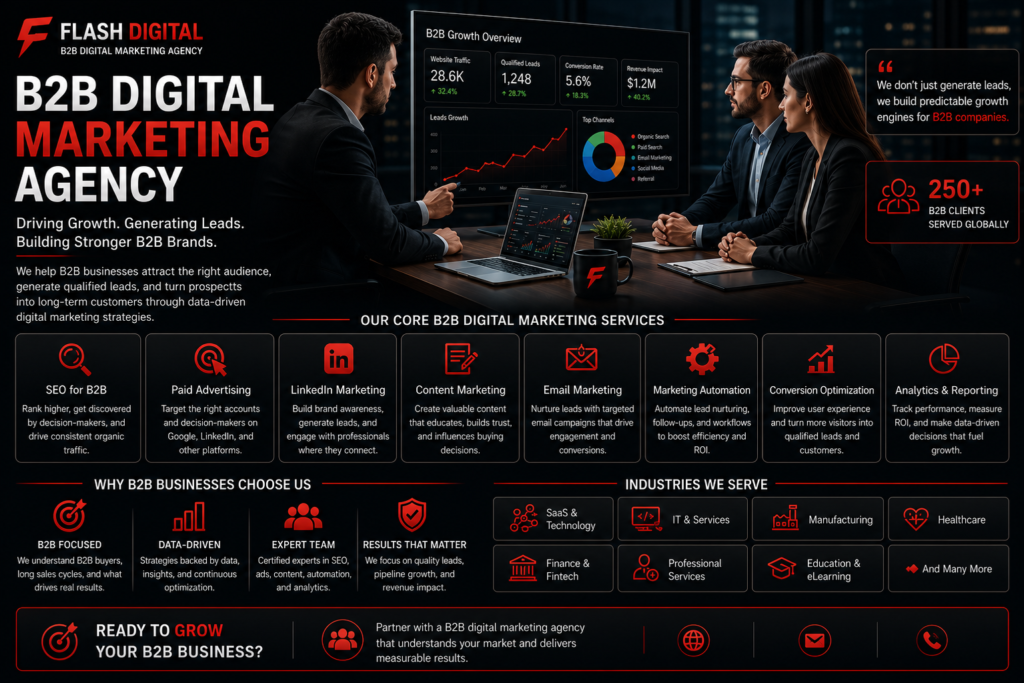
Day to day, a B2B digital marketing agency wears a lot of hats. Here’s what that typically includes:
● Strategy development — mapping out the buyer journey and deciding where to focus budget and effort
● Online marketing — managing the brand’s digital presence across search, social, and email
● SEO — making sure the company shows up when potential buyers search for solutions
● Content marketing — producing blogs, whitepapers, and case studies that build authority
● Lead generation — turning website visitors into names the sales team can actually call
● Paid advertising — running LinkedIn, Google, and retargeting campaigns to speed up pipeline
● Analytics — tracking what’s working, what isn’t, and adjusting spend accordingly
Put simply, what does a B2B digital marketing agency do? It handles everything between “nobody has heard of us” and “here’s a qualified lead ready for a sales call.” Most agencies assign a small team — usually a strategist, a content or SEO lead, and a paid media specialist — rather than throwing the account to one generalist.
FAQs
Almost every B2B-facing sector uses it — SaaS, manufacturing, logistics, IT services, consulting, and industrial equipment are some of the heaviest users.
Not at all. Small and mid-sized companies often see faster wins because their sales cycle and budget approval process are shorter.
Yes — startups often benefit the most, since an agency brings instant expertise and tools a young company hasn’t had time to build in-house.
How Does a B2B Digital Marketing Agency Work?
Most agencies follow a fairly predictable rhythm, even if the specific tactics change from client to client. It usually starts with research — understanding the target market, the competitors, and where the current website and content are falling short. From there, planning takes over: setting goals, picking channels, and building out a 90-day or 6-month roadmap.
Execution is where the actual work happens — writing content, launching campaigns, optimizing landing pages, and setting up tracking. Then comes optimization, which is really just a nice way of saying “testing and fixing what isn’t converting.” Finally, reporting closes the loop, showing the client exactly what happened to their traffic, leads, and pipeline over the reporting period, usually monthly.
So, how does a B2B digital marketing agency work in practice? Think of it as a five-stage cycle — research, plan, execute, optimize, report — that repeats every month or quarter, getting sharper each time as more data comes in.
Why Businesses Need B2B Digital Marketing
Buyer behavior has changed dramatically. Studies on B2B purchasing consistently show that buyers complete a large chunk of their research — often more than half — before they ever speak to a salesperson. If your competitor’s website answers their questions and yours doesn’t, you’ve likely already lost that deal without knowing it.
Competition online has also gotten more crowded. A decade ago, a decent website and a LinkedIn page were enough to stand out. Now, buyers are bombarded with content from every vendor in the category, so brand visibility takes deliberate, consistent effort — not a one-off campaign.
This is exactly why businesses need B2B digital marketing: it builds visibility while the buyer is still just browsing, keeps the brand top of mind through the long consideration period, and ultimately drives the lead generation that keeps the sales pipeline full.
Difference Between B2B and B2C Digital Marketing
The difference between B2B and B2C digital marketing comes down to a handful of core factors:
● Audience — B2B targets specific job roles and committees; B2C targets broad consumer segments
● Buying journey — B2B involves research, comparison, and internal approval; B2C is often a single-step decision
● Sales cycle — B2B deals can take months; B2C purchases can happen in minutes
● Decision making — B2B purchases usually need sign-off from multiple stakeholders; B2C is typically one person’s call
● Messaging — B2B content leans on data, ROI, and case studies; B2C leans on emotion and lifestyle
Neither approach is “harder” in a universal sense — they’re just solving different problems. B2B marketing has to nurture a lead patiently for months, while B2C marketing has to catch attention and convert it almost instantly.
Key B2B Digital Marketing Strategies
There’s no single formula, but the best B2B digital marketing strategies tend to combine a handful of channels rather than relying on just one:
● SEO to capture buyers actively searching for a solution
● Content marketing to educate prospects and build trust over time
● Email marketing to nurture leads who aren’t ready to buy yet
● PPC (pay-per-click) to generate faster visibility while SEO is still building momentum
● Social media to keep the brand present in industry conversations
● LinkedIn specifically, since it remains the strongest platform for reaching B2B decision-makers
A useful rule of thumb: SEO and content build the long-term engine, while PPC and LinkedIn ads fill the gap in the short term. Agencies typically run both at once rather than picking one over the other.
The Importance of B2B Lead Generation
Lead generation is the process of identifying people who might buy from you and collecting enough information to start a conversation — a name, an email, a company, maybe a phone number. In B2B, this usually happens through gated content, demo requests, newsletter sign-ups, or LinkedIn lead forms.
Every lead generation strategy for B2B businesses ultimately feeds into the marketing funnel: awareness at the top, consideration in the middle, and decision at the bottom. Not every lead is equal, though — a qualified lead is someone who actually fits the buyer profile and has a real reason to purchase, versus someone who downloaded a whitepaper out of curiosity.
Conversion is the final step, where a qualified lead becomes an actual customer. The whole point of B2B lead generation is to keep that funnel full enough that sales always has someone worth calling.
FAQs
It’s not harder, just different — B2B requires more patience and nurturing due to longer sales cycles and multiple decision-makers.
Absolutely. Most B2B buyers start their research on Google, so ranking for the right keywords directly affects how many leads come in.
Paid campaigns can show results within weeks, while SEO and content typically need three to six months to gain real traction.
Benefits of Hiring a B2B Digital Marketing Agency
Plenty of companies try to handle marketing in-house, and that works fine for some. But there are real, measurable benefits of hiring a B2B digital marketing agency that make outsourcing worth considering:
● Expertise — agencies work across dozens of accounts, so they’ve already tested what works and what wastes budget
● Cost savings — hiring an agency is often cheaper than building an entire in-house team of specialists
● Better ROI — dedicated strategists tend to spend budget more efficiently than a generalist juggling five other tasks
● Scalability — agencies can ramp up or down based on your budget and season, without a hiring or layoff process
● Access to tools — most agencies already have premium SEO, analytics, and automation software most businesses wouldn’t buy on their own
These benefits of B2B digital marketing compound over time. A company running on borrowed expertise from day one usually reaches profitable campaigns faster than one that’s still learning the basics through trial and error.
How do B2B agencies generate leads in practice? Usually through a mix of SEO-driven organic traffic, gated content offers, and targeted LinkedIn or Google campaigns — then nurturing those contacts with email until they’re ready to talk to sales. And yes, small businesses can absolutely use B2B digital marketing; in fact, a lean, well-targeted campaign often performs better for a smaller company than a scattered, unfocused one for a larger competitor.
B2B SEO Services Explained
SEO for B2B companies works a little differently than SEO for a retail store or restaurant. The search volume for B2B terms is usually lower, but the intent behind each search is much higher — someone Googling “inventory management software for warehouses” is far closer to buying than someone browsing “best running shoes.”
B2B SEO services typically include keyword research focused on buyer intent, technical SEO to make sure the site actually loads fast and crawls cleanly, on-page SEO to structure content around what buyers are searching, link building to establish authority in the industry, and ongoing content optimization to keep older pages ranking as competition shifts.
It’s also worth mentioning that some B2B companies — especially agencies or consultants themselves — get local searches too. A phrase like “B2B digital marketing agency near me” still shows up in search data, usually from business owners who prefer working with a local team they can meet in person, even in an industry that’s largely remote-friendly.
B2B Content Marketing and Its Role
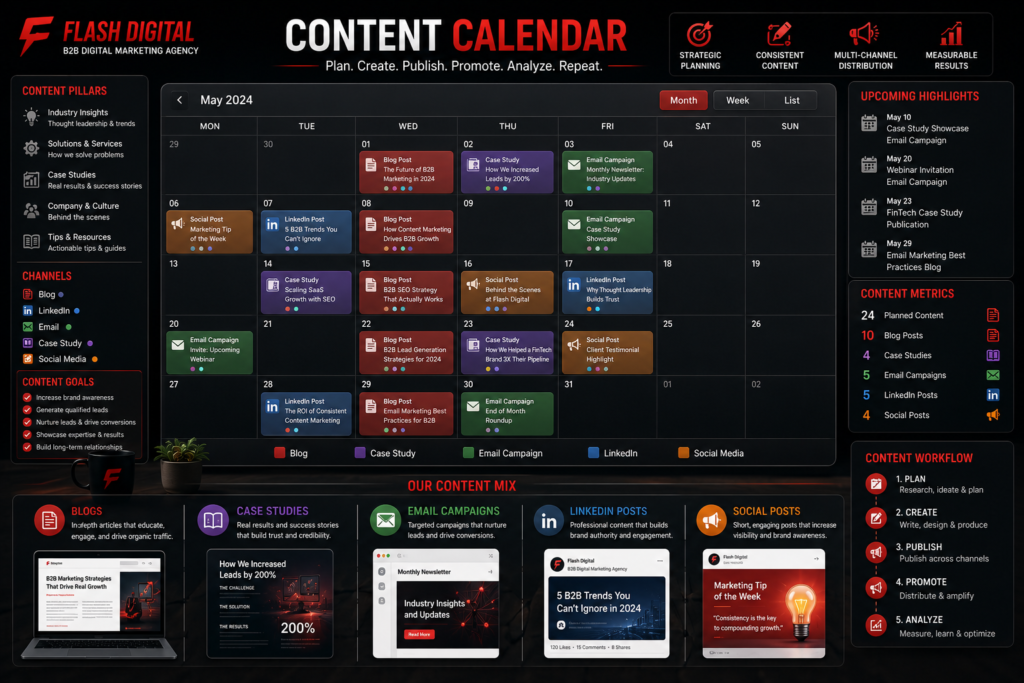
B2B content marketing is the engine behind almost everything else on this list — SEO needs content to rank, lead generation needs content to convert, and sales teams lean on content to answer buyer objections. The most effective formats tend to be:
● Educational content that answers real questions buyers are asking
● Blogs that build topical authority and long-term organic traffic
● Whitepapers that go deep on a specific problem for buyers doing serious research
● Case studies that show real results from real customers
● Email newsletters that keep leads engaged between purchase stages
The businesses that win at content marketing usually aren’t the ones publishing the most — they’re the ones publishing content that actually answers the exact question a buyer typed into Google.
B2B Digital Marketing for Small Businesses
B2B digital marketing for small businesses doesn’t need a massive budget to work — it needs focus. Rather than trying to compete on every channel, smaller companies tend to do better picking one or two strategies (usually SEO plus LinkedIn, or content plus email) and doing them consistently for six months rather than spreading thin across everything at once.
Budget-friendly strategies like organic content, guest posting, and community engagement on LinkedIn can build authority just as effectively as paid ads — they just take longer. And because digital channels aren’t limited by geography, a five-person consultancy can realistically compete for both local and global clients from the same website.
How to Choose a B2B Marketing Agency
Knowing how to choose a B2B marketing agency saves a lot of wasted budget and frustration. A few things worth checking before signing anything:
● Experience — how long have they worked specifically with B2B clients, not just consumer brands?
● Industry knowledge — have they worked with companies in your space, or something close to it?
● Portfolio — can they show real campaigns and real results, not just logos?
● Transparency — will they tell you honestly when something isn’t working?
● Reporting — do they provide clear, regular updates on performance?
● Communication — is there a dedicated point of contact, or will you be emailing a group inbox?
A quick gut check: if an agency promises guaranteed rankings or a specific number of leads within 30 days, that’s usually a red flag rather than a selling point. Good B2B marketing takes time to compound.
Common Challenges in B2B Digital Marketing
Even with the right strategy, B2B digital marketing comes with some built-in challenges. Long sales cycles make it hard to tie a single campaign directly to revenue for months at a time. Complex audiences mean the messaging has to speak to several roles at once — a technical buyer and a budget-holder rarely care about the same details.
High competition means many industries are now fighting for the same limited pool of search terms and LinkedIn attention. And measuring ROI can get messy when a deal touches five or six different marketing pieces before it closes. Keeping content relevant is an ongoing job too — a blog post that ranked well two years ago can quietly lose ground if it’s never updated.
Conclusion
A B2B digital marketing agency exists to close the gap between “our product is genuinely good” and “the right buyers actually know we exist.” From SEO and content to lead generation and paid campaigns, the goal is always the same — get in front of the right decision-makers at the right point in their research, and keep nurturing them until they’re ready to talk.
Choosing the right strategy matters more than chasing every trend. A company that commits to one or two channels and does them well will almost always outperform one that spreads its budget across everything and masters nothing.
Looking ahead, expect B2B digital marketing to lean further into personalization, AI-assisted content research, and account-based marketing that treats each target company almost like its own micro-campaign. The businesses that adapt early will have a real head start.
Related Questions for Future Articles
- What trends are shaping the future of B2B digital marketing?
- What are the best B2B digital marketing strategies for 2026?
- How does SEO help B2B companies generate more leads?
- What is B2B lead generation and why is it important?
- How do you choose the right B2B marketing agency?
- What are the most effective B2B SEO strategies?
- What are the biggest challenges in B2B digital marketing?
- What KPIs should businesses track in B2B digital marketing?