What Do Web Developers Do
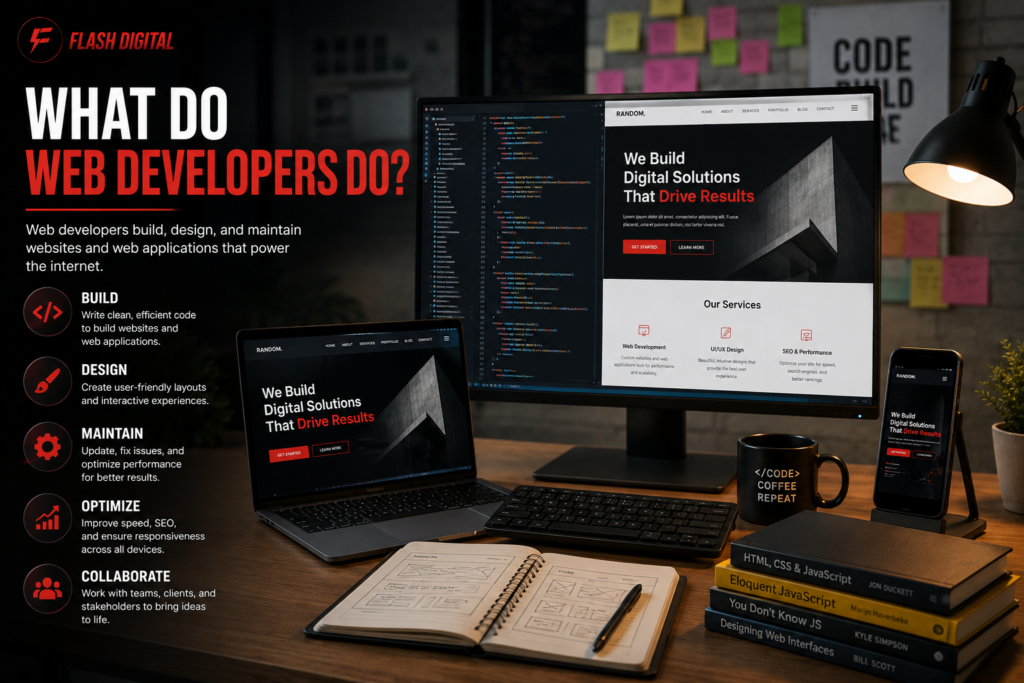
What Do Web Developers Do? A Complete Guide to the Role Behind Every Website
Why the Question Comes Up More Than You’d Think
Open your banking app. Order coffee online. Buy something at midnight because you couldn’t sleep and your cart was just sitting there. Somewhere behind every single one of those moments, somebody sat down and wrote the code that made it work. Most people never think about this stuff. Why would they? It’s usually only when something breaks — or when they need a site of their own and suddenly realize they have no idea what they’d actually be paying for — that the question even comes up.
And it comes up looking something like this: what does a web developer actually do all day? Is it something worth paying for, or can a cheap template handle it just as well?
What You’ll Get Out of This Guide
No fluff here, honestly. What web development really is. What the work looks like on a normal day. The different kinds of developers, and what each one is actually for. Roughly what it all costs. And since a good chunk of people reading this are around Austin, a bit on finding the right person or team locally too. Get through this, and “what do web developers do” stops being just a job title — it turns into something you actually understand.
What Is Web Development, Anyway?
Web development is building and keeping up websites and web apps. Simple sentence, huge range hiding underneath it — a five-page site for your neighborhood dentist, a full online store, or the dashboard some software company built that you log into half-asleep every morning. Part technical, part creative. Probably why the field pulls in such a weirdly wide mix of people, honestly.
Front-End, Back-End, Full-Stack
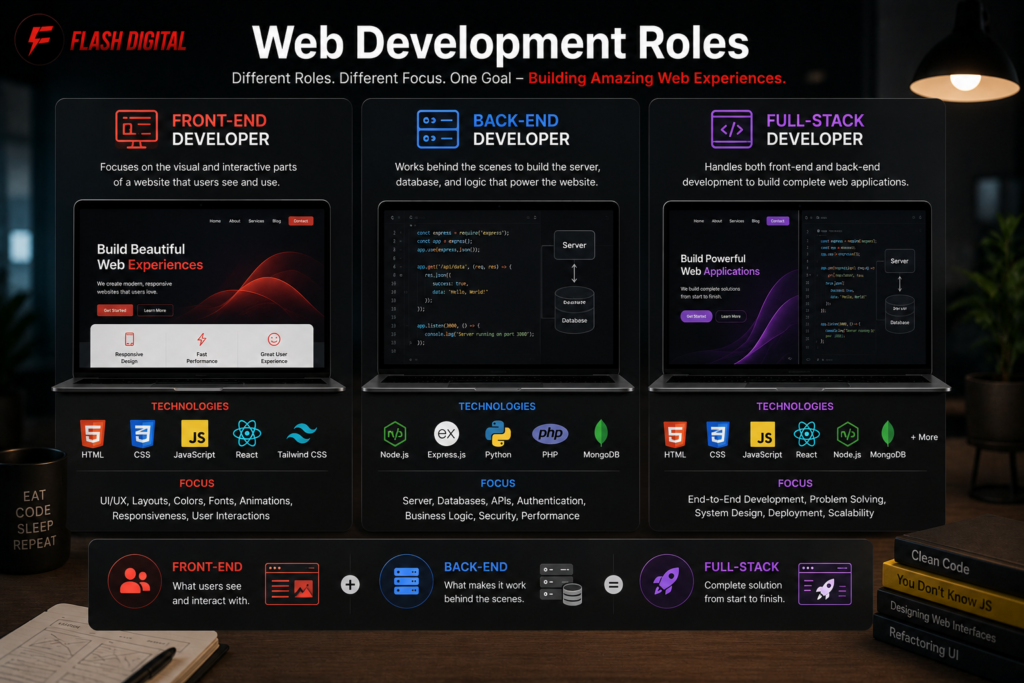
Front-end is what you actually see and click. Back-end is the server and database stuff grinding away underneath, invisible right up until it breaks. Full-stack developers do both. Most projects need all three covered in some form, whether that’s one full-stack person juggling everything alone, or a small team where everyone’s got their own piece to worry about.
Why a Business Actually Needs One of These People
A site that exists, and a site that actually works for the business — not the same thing. Not even close, really. And that gap is basically where a developer earns their paycheck. It’s the difference between a contact form quietly eating half its submissions and one that just works, no drama involved. Between a checkout page silently losing sales every week and one that isn’t.
What Do Web Developers Do, Step by Step?
Planning comes first. Always. Before anyone touches code, somebody has to nail down what the site’s even for — leads, sales, bookings, whatever — and what other tools it needs to connect with.
Then front-end work happens. Layout, buttons, forms, the whole visible package, built with HTML, CSS, and JavaScript — React, more often than not these days — so it looks right and doesn’t fall apart the second someone opens it on their phone.
Back-end comes next, quietly, tucked behind all of that. Server logic. Databases. Whatever stores what people type into forms, processes orders, keeps user accounts straight, talks to other software the business already relies on.
Testing across devices and browsers — genuinely not optional, even though it gets treated that way sometimes. A site can look flawless on a MacBook and fall apart in small annoying ways on somebody’s beat-up three-year-old Android.
And then launch. Which, weirdly, isn’t really the finish line at all. Updates. Security patches. That random afternoon “wait, why did this just break” moment. That’s what the job actually looks like once real people start using the thing.
So, roughly, that’s the shape of it: plan, build the front, build the back, test it, keep it alive. Over and over. Project after project.
FAQ
No — and honestly this confuses people all the time. Design is how something looks and how it’s laid out. Development is the actual building part, the code underneath making that design function in the real world.
For smaller stuff, sure, easily. A solid full-stack developer can run the entire project alone. Once things get bigger or more complicated, though, you’re usually looking at a small team instead.
Sometimes, yeah — though technically they’re separate skills. Plenty of freelancers and small studios handle both sides. Bigger shops usually split it up: designer builds the mockup, developer turns it into something that actually works.
The Different Types of Web Developers
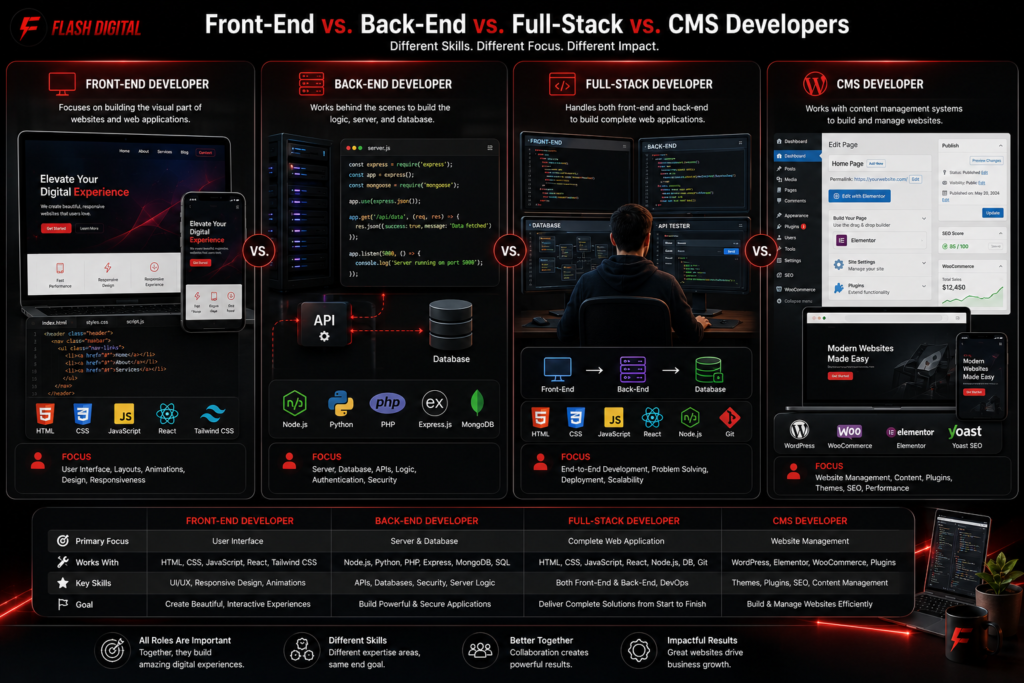
Front-end developers live in the visible layer. Layout, navigation, buttons, whatever little animation makes a site feel polished instead of janky — that’s their world. Back-end developers work the other side: servers and databases and logic that nobody ever sees directly, even though everyone leans on it constantly. Full-stack developers cover both, which is exactly why they’re so useful on small-to-mid-sized projects — paying for a separate specialist at every single layer just doesn’t make sense at that scale. And then you’ve got developers who specialize specifically in platforms like WordPress, building custom themes so a business owner can go update things themselves later without touching any code.
Tools and Languages, Briefly
HTML and CSS handle structure and styling. JavaScript makes things interactive, usually through something like React or Vue. On the back-end, you’ll run into PHP, Python, Node.js — handling the logic and database work. Git tracks every change so nothing gets lost when a few people are elbow-deep in the same codebase at once. How much of this stack actually gets used depends entirely on the project. A basic small-business site needs a fraction of what a custom app juggling logins and payments would.
What Actually Makes a Developer Good at This Job
Technical skill only gets you halfway. The developers whose work actually holds up long-term also tend to communicate well — they can explain a trade-off to a client who’s never seen a line of code and somehow make it land. They catch the small bugs before a customer ever does. And they keep learning, because standing still just isn’t really an option in this line of work — the tools shift under your feet constantly, whether you like it or not.
What Separates a Smooth Project From a Painful One
Clear goals, set before anyone opens a design tool or a code editor. Skip that step, and everyone ends up guessing what “done” even means six weeks in. Real wireframes and planning — not designing on the fly inside a browser window as you go along. Code written like someone else might have to maintain it someday, not just shipped and forgotten about. Testing on actual devices, not a five-second glance on whatever laptop’s already open. And, probably the most overlooked one, an actual plan for after launch — because that’s usually where a project either keeps paying off for years, or quietly starts rotting.
Web Development for Small Businesses
Realistic on a small budget? Usually, yeah, as long as the scope makes sense. A well-planned five-to-eight page site tends to cost way less than people assume — especially set against what a bad DIY site quietly costs a business in missed opportunities over a year or two.
DIY builders are fine, genuinely, for something small and simple. They hit a wall fast the second a business needs custom functionality, real speed, or a site actually built to show up in search instead of just sitting somewhere on page four.
Why do small businesses hire developers at all? Usually because they’ve outgrown whatever DIY thing they started with, or a redesign spiraled into something way more complicated than expected, or — honestly probably the most common reason — they’d rather just run their business than argue with a website builder at 11 pm on a Tuesday night.
FAQ
Four to six weeks, roughly, kickoff to launch. Content readiness moves that number around more than most people expect going in, for what it’s worth.
Often, yes. If the content and structure underneath are actually solid, a developer can rework the design and clean up the technical issues without starting from zero.
Depends on scope, but a lot of small business sites land somewhere in the low thousands. E-commerce or anything custom pushes that number up, sometimes a good bit.
A Few Best Practices Worth Knowing
Mobile responsiveness stopped being optional a long time ago now — most visitors show up on a phone, not a desktop, so that’s genuinely where testing should start, not end. Page speed matters just as much. A slow site loses people before they’ve even seen anything worth sticking around for. Accessibility is worth building in from day one, not just because it’s the right thing to do but because bolting it on later is a way bigger job than doing it upfront would’ve been. SEO belongs baked into the build itself, not tacked on six months later like some kind of afterthought. And none of it holds up without someone actually maintaining the site once it’s live — treating launch as the finish line is exactly how good sites quietly go stale.
Mistakes Businesses Make When Hiring a Developer
Picking whoever quoted the lowest number, without ever once looking at their actual past work — that’s usually mistake number one, and it’s often the most expensive mistake in hindsight, by a mile. Skipping the planning conversation and jumping straight into design feels like progress in the moment, but it usually just means redoing things later, sometimes twice over. Not asking upfront who actually handles support once the site’s live is a surprisingly common gap, and it leaves people stuck the second something inevitably breaks. And still, somehow, treating mobile testing like some optional extra instead of standard practice — given how much traffic comes from phones now, that one really shouldn’t still be happening in 2026.
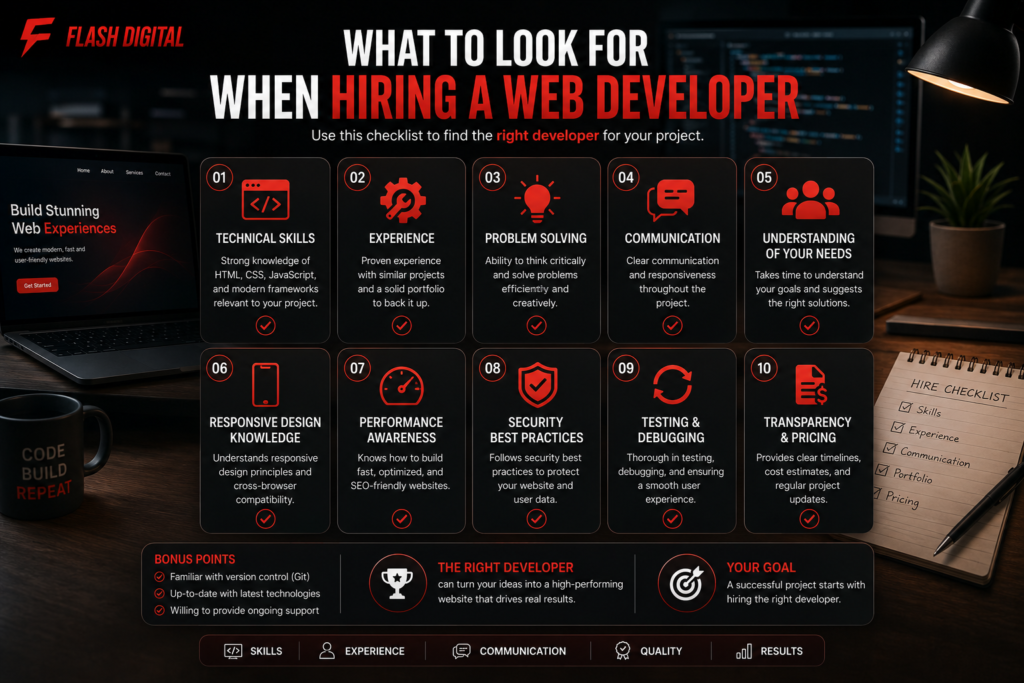
How to Actually Pick the Right Developer
Ask to see real, live sites — not polished mockups, which can hide a lot that a finished, working site simply can’t hide. Ask how SEO fits into the build process itself, not as some afterthought bolted on later; the answer tells you a surprising amount about how a team actually thinks. Get the maintenance plan in writing, if you can. And get a real timeline plus a real cost breakdown before signing a single thing, because a vague answer here is usually a preview of exactly how the rest of the project’s going to go.
How Much Does Hiring a Developer Actually Cost?
Cost comes down to complexity, how many custom features are involved, whether e-commerce is part of it, and how much content already exists versus needing to be written from scratch. A simple business site can start in the low thousands. Custom builds with e-commerce or specialized functionality often climb well into five figures, depending on scope. When budgeting, start with a clear must-have versus nice-to-have list, get a few quotes on identical scope so you’re actually comparing apples to apples, and stay a little suspicious of any quote that comes in dramatically lower than the rest — that gap usually means something got quietly left out somewhere.
Why Austin Businesses Choose Flash Digital
Working with a developer you can actually sit across a table from tends to move faster than a marketplace hire on the other side of the planet. Feedback happens in real time. There’s real accountability, too, if something needs to change after launch — not just a support ticket vanishing into some queue nobody ever checks.
Austin’s business scene has grown fast, and the online competition’s grown right along with it. A team that actually understands the local market builds with that competition in mind, instead of slapping the same generic template on every client regardless of who they’re up against.
Flash Digital, based right here in Austin, TX, builds sites around what a business actually needs to grow — clear goals, clean code, SEO fundamentals baked in from day one, not some site that just sits there looking finished while doing basically nothing. If you’ve been searching for a web developer in Austin, TX, or typed “web development company near me” after a DIY attempt didn’t hold up the way you hoped it would, that’s exactly the gap Flash Digital works to close. Reach out through flashdigi.com to talk through what a project would actually look like for your business.
So, What Do Web Developers Do?
Plan. Build. Test. Keep the whole thing running long after launch day. The parts people see, and the parts they never notice at all — both handled by someone who actually understands how the whole thing fits together.
That understanding changes how a business should think about hiring one in the first place. It’s not just about getting pages built. It’s about ending up with a site that still works months, years even, down the line — not just on launch day itself. For a business without the time or the in-house know-how to manage all that, working with a team like Flash Digital is often the difference between a website that technically exists and one that’s actually pulling its weight.
Related Questions
- What is the difference between front-end and back-end development?
- What is a full-stack developer?
- What tools and languages do web developers use?
- What makes a website project successful?
- What is a WordPress or CMS developer?
- What is the best web development company in Austin, TX?
- Should a business hire a local web developer or work remotely?
- Is web development the same as web design?