How Much Does Google Ads Cost? Complete 2026 Pricing Guide for Businesses

Why Google Ads Costs Matter for Business Growth
“How much does Google Ads cost?” is one of those questions that sounds simple until you actually start digging for an answer. Search for it and you’ll find a dozen different numbers — $1 per click, $50 per click, $1,000 a month, $10,000 a month — and none of them are wrong, exactly. They’re just describing completely different businesses in completely different industries.
Google Ads cost isn’t a flat fee like a software subscription. It’s an auction, and what you pay depends on who else is bidding against you, how relevant your ads and landing pages are, and how competitive your industry happens to be. A personal injury lawyer and a local dog groomer are both running “Google Ads,” but their cost per click can differ by 50x.
In this guide, we’ll break down exactly what drives the cost of Google Ads, what realistic budgets look like across different business types and industries, what agencies typically charge to manage campaigns, and how to keep your spend efficient instead of just throwing money at the auction and hoping. By the end, you’ll have a genuinely useful budget range instead of a guess pulled from a random forum thread.
What Determines Google Ads Cost?
Google Ads Auction Explained
Every time someone searches on Google, an auction runs behind the scenes in a fraction of a second. Advertisers bidding on that keyword get evaluated, and the winner isn’t necessarily the highest bidder — it’s whoever has the best combination of bid amount and ad quality.
Cost Per Click (CPC)
Cost per click is exactly what it sounds like: the amount you pay when someone clicks your ad. Google Ads CPC is determined by your bid, your competitors’ bids, and your Quality Score, and it can range from under $1 for low-competition niches to $50+ for keywords like “personal injury lawyer” or “business insurance.”
Quality Score and Ad Rank
Quality Score is Google’s 1–10 rating of how relevant your ad, keyword, and landing page are to the person searching. Ad Rank combines your bid with your Quality Score (plus a few other signals) to decide your ad position. This matters because a high Quality Score can actually lower your Google Ads CPC — Google essentially rewards ads it thinks people will find useful.
Competition and Industry
The more advertisers bidding on a keyword, the higher the price climbs. Industries with high customer lifetime value — legal, finance, home services — see far higher Google Ads pricing than, say, a local bakery advertising “birthday cakes near me.”
Average Google Ads Cost in 2026
Average Cost Per Click
Across most industries, the average Google Ads cost per click in 2026 falls somewhere between $2 and $6 on the Search Network, though this shifts dramatically by industry — legal and insurance keywords regularly exceed $20–$50 per click, while lower-competition local services often stay under $3.
Average Monthly Google Ads Cost
Google Ads monthly cost for a small to mid-sized business typically ranges from $1,000 to $10,000, with many small businesses landing in the $1,500–$5,000 range once you factor in both ad spend and management. Larger eCommerce or national campaigns can run well into six figures monthly.
Average Cost Per Conversion
Cost per conversion varies just as much as CPC — a local service business might pay $20–$60 per lead, while an eCommerce store selling a $30 product needs its cost per conversion to stay well under that number to remain profitable.
Google Ads Cost by Business Type
Local Service Businesses
Plumbers, electricians, HVAC companies, and similar local services often see CPCs between $5 and $15, with monthly budgets commonly in the $1,000–$4,000 range for a single city.
eCommerce Stores
eCommerce campaigns, especially Shopping ads, often run on lower individual CPCs ($0.50–$3) but require higher overall spend because of volume — Google Ads campaign cost for eCommerce brands frequently starts at $2,000–$5,000/month to generate meaningful sales data.
Professional Services
Law firms, accountants, and consultants face some of the highest CPCs in paid search — often $10–$50+ per click — because a single client can be worth tens of thousands of dollars.
SaaS & B2B Companies
B2B and SaaS companies typically see moderate CPCs ($3–$15) but longer sales cycles, meaning cost per conversion needs to be evaluated against customer lifetime value, not just the initial click.
FAQ
Your budget should match your goals, competition level, and expected return on investment — there’s no universal number that works for every business.
Costs vary widely based on industry, competition, and campaign quality, so “expensive” is relative to what a customer is worth to your business.
Google primarily uses daily budgets that you set yourself, and those daily amounts add up to determine your total monthly spend.
Google Ads Budget: How Much Should You Spend?
Choosing the Right Starting Budget
A reasonable starting point for most small businesses testing Google Ads is $1,000–$2,000/month, which is usually enough to gather real click and conversion data within 30–60 days without burning cash on guesswork.
Budget Based on Business Goals
If you’re trying to fill a handful of appointment slots each week, your Google Ads budget can stay modest. If you’re trying to scale an eCommerce brand nationally, your budget needs to scale with your inventory and margins.
Scaling Your Campaigns
Once you know your cost per conversion and it’s profitable, scaling usually means increasing budget in 15–20% increments rather than doubling overnight — Google’s algorithm needs time to adjust to bigger spend without losing efficiency.
Google Ads Pricing for Small Businesses
Typical Small Business Budgets
How much does Google Ads cost for a small business? Most small businesses we work with start between $800 and $3,000/month in ad spend, separate from any management fees.
Budget-Friendly PPC Strategies
Tight geographic targeting, a focused keyword list instead of broad match everything, and dayparting (only running ads during business hours) all stretch a small budget further without sacrificing lead quality.
Maximizing ROI
Google Ads ROI improves fastest when businesses fix their landing pages before increasing spend — sending more clicks to a weak page just means paying more to lose more leads.
Google Ads Cost in Austin, TX
Local Competition
Austin’s tech-heavy, fast-growing business scene means Google Ads cost in Austin TX runs a bit higher than the national average in several industries — real estate, home services, and legal especially, thanks to steady population growth and no shortage of companies competing for the same searches.
Industry Demand in Austin
Home services and real estate see some of the sharpest local competition, with CPCs for terms like “roof repair Austin” or “Austin realtor” often landing above national averages for comparable service categories.
Factors Affecting Austin PPC Costs
Seasonal demand (HVAC in July, for instance), the sheer number of small businesses competing for local visibility, and Austin’s above-average cost of living all factor into what local advertisers end up paying per click.
Google Ads Agency Pricing Explained
Flat Monthly Management
Many agencies charge a flat monthly management fee, commonly $500–$2,500/month for small to mid-sized accounts, regardless of ad spend.
Percentage of Ad Spend
Others charge a percentage — typically 10–20% of monthly ad spend — which scales the management fee alongside the campaign budget.
Performance-Based Pricing
Some agencies tie fees to results (cost per lead or a share of revenue generated), which can align incentives well but requires very clean conversion tracking to work fairly.
One-Time Setup Fees
Expect a one-time setup fee of $300–$1,500 for initial account structuring, conversion tracking installation, and campaign build-out, separate from ongoing management.
FAQ
Yes, agency management fees are separate from your advertising budget — your ad spend goes to Google directly, and the management fee is a separate line item.
A skilled agency can improve campaign performance, tighten targeting, and reduce wasted ad spend, often making up the difference in management fees through better efficiency.
Yes, but professional management often delivers better optimization and ROI, especially once budgets grow past a few thousand dollars a month.
Google Ads Cost Per Click by Industry
Legal
Legal keywords remain among the most expensive in paid search, often $20–$100+ per click for terms like “car accident lawyer,” driven by extremely high case values.
Healthcare
Healthcare CPCs vary widely — $2–$15 for general services, higher for specialties with expensive procedures or elective treatments.
Home Services
Home services (roofing, HVAC, plumbing) typically run $5–$20 per click, with emergency-related terms (“emergency plumber”) often pricing higher.
Real Estate
Real estate CPCs generally land between $1 and $10, though luxury and commercial real estate searches can climb higher.
eCommerce
eCommerce keeps CPCs relatively low individually ($0.50–$3), relying on volume and Shopping campaigns rather than single high-value clicks.
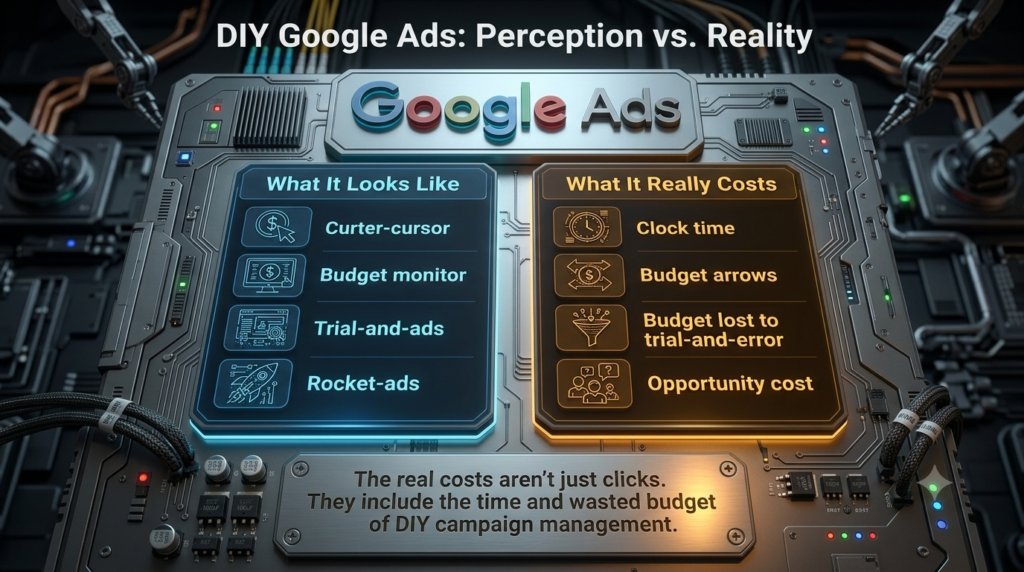
Hidden Costs of Running Google Ads
Landing Page Development
A dedicated, conversion-optimized landing page (rather than sending traffic to a generic homepage) typically costs $300–$1,500 to build but often pays for itself through a higher conversion rate.
Conversion Tracking
Proper conversion tracking setup — Google Tag Manager, call tracking, form tracking — is easy to skip and expensive to ignore, since campaigns optimize badly without accurate data.
Creative Assets
Ad copy, images, and video for Display and YouTube campaigns add cost, whether you’re paying a freelancer or an agency for design work.
Ongoing Optimization
Google Ads optimization isn’t a set-it-and-forget-it task. Weekly or biweekly adjustments to bids, keywords, and ad copy are part of what keeps Google Ads performance improving over time instead of stagnating.
How to Lower Your Google Ads Costs
Improve Quality Score
A higher Quality Score directly lowers your CPC for the same ad position — tightening keyword-to-ad-to-landing-page relevance is the single biggest lever most accounts leave untouched.
Better Keyword Targeting
Broad match without careful monitoring burns budget fast. Phrase match and exact match, paired with solid keyword research, keep spend focused on searches that actually convert.
Negative Keywords
Adding negative keywords (terms you don’t want to show up for) prevents wasted clicks from irrelevant searches — a roofing company bidding on “roofing” without excluding “DIY roofing” will burn through budget on people who were never going to hire anyone.
Better Landing Pages
Faster load times, clear calls to action, and mobile-friendly design all improve conversion rate, which lowers your effective cost per conversion even if CPC stays the same.
Smart Bidding
Google’s automated bidding strategies (Target CPA, Target ROAS) can outperform manual bidding once a campaign has enough conversion data, usually 30+ conversions in the last 30 days.
Is Google Ads Worth the Cost?
Benefits for Small Businesses
Google Ads puts a business in front of people actively searching for what they sell, right now — that intent is hard to replicate with most other advertising channels.
Measuring ROI
Google Ads ROI should be measured against actual revenue or lead value, not just clicks or impressions. A $3,000/month campaign that generates $15,000 in new business is working, even if the CPC looks high on paper.
When Google Ads Delivers the Best Results
Businesses with a clear, calculable customer value — a $5,000 average roofing job, a $200 average online order — tend to see the clearest ROI, since it’s easy to know exactly what a lead or sale can cost and still be profitable.
FAQ
Many campaigns generate traffic quickly, sometimes within hours of launch, but real optimization and stable results typically take 4–8 weeks.
Yes, campaigns and budgets can be adjusted or paused whenever needed, with changes usually taking effect within minutes.
No, campaign quality and optimization matter more than budget alone — a well-optimized $1,500/month campaign can outperform a poorly managed $5,000/month one.
Google Ads Cost Calculator: Estimating Your Budget
Factors Included in Cost Estimates
A useful Google Ads cost calculator for businesses factors in your industry’s average CPC, expected click volume, target number of leads or sales, and your realistic conversion rate — not just a flat monthly number pulled out of thin air.
Budget Planning Tips
Work backward from your goal: if you need 20 leads a month and your industry averages a 5% landing page conversion rate at $8 CPC, you’re looking at roughly $3,200/month in ad spend before management fees.
Understanding ROI Before You Spend
Know your average customer value before setting a budget. Without that number, it’s impossible to know whether a given cost per conversion is a win or a loss.
Common Google Ads Budget Mistakes to Avoid
Targeting Too Broadly
Casting too wide a net — broad match keywords, no geographic restrictions, no audience exclusions — burns budget on clicks that were never going to convert.
Ignoring Conversion Tracking
Running campaigns without tracking is like driving with your eyes closed; you have no idea which keywords or ads are actually generating business.
Not Testing Ads
Running a single ad variation forever means missing out on the performance gains that come from testing headlines, offers, and calls to action against each other.
Stopping Campaigns Too Early
Pulling the plug after two weeks because results “aren’t there yet” is one of the most common — and costly — mistakes. Google Ads performance typically needs 4–6 weeks of data before real conclusions can be drawn.
Building the Right Google Ads Budget for Long-Term Growth
So — how much does Google Ads cost? For most small to mid-sized businesses, realistic Google Ads pricing lands somewhere between $1,000 and $10,000 a month in ad spend, plus management costs if you’re not running campaigns in-house. The real answer depends on your industry’s CPC, your business goals, and how competitive your local or national market is.
Whether you manage campaigns yourself or bring in outside help, the businesses that get the best return treat Google Ads management cost as an investment in data and optimization, not just a line item for clicks. Track conversions properly, fix your landing pages before scaling spend, and give campaigns enough time to actually gather data before judging results.
Flash Digital, based in Austin, TX, has managed Google Ads campaigns for local service businesses, eCommerce brands, and professional firms across Central Texas and beyond — from lean $1,000/month local campaigns to larger multi-market accounts. If you’re a business searching for Google Ads management near me and trying to figure out a realistic budget for your specific industry, that’s exactly the kind of conversation worth having before you spend a dollar with Google.
Related Questions
- How does Google Ads billing work?
- What is a good Google Ads budget for beginners?
- How much does Google Ads cost per click?
- What affects Google Ads CPC?
- How does Google Ads billing work?
- How does PPC compare to SEO?
- What industries pay the highest Google Ads CPC?
- How do Google Ads agencies price their services?