How Do I Target Ads Effectively on Social Media
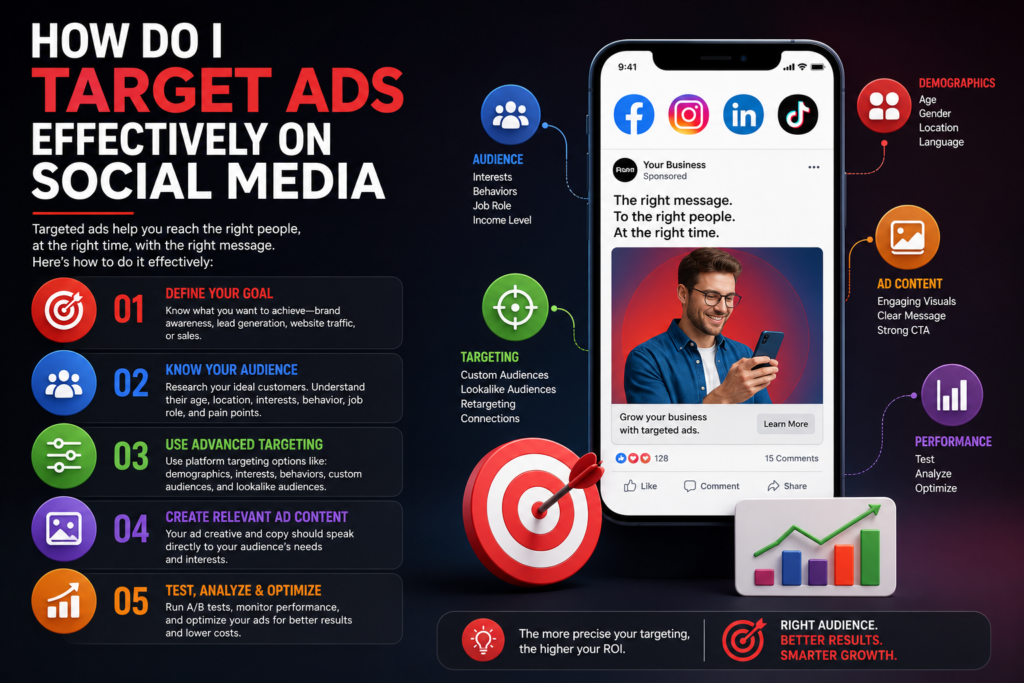
How Do I Target Ads Effectively on Social Media? A Complete 2026 Guide
Why Targeting Matters More Than Your Ad Budget
Here’s a scenario that plays out every day: two businesses spend the exact same $1,000 on Facebook and Instagram ads. One gets 40 leads. The other gets 4. The difference almost never comes down to the ad creative or the offer — it comes down to who saw the ad in the first place.
That’s the honest answer to “how do I target ads effectively on social media?” You can write the best headline in the world, but if it’s showing up in front of the wrong person’s feed, it doesn’t matter. Social media ad targeting is the single biggest lever most businesses aren’t pulling hard enough.
What You’ll Learn in This Guide
This guide walks through what social media ad targeting actually is, why it matters more than most people realize, how to find your real audience (not just a guess), and the specific strategies that work on Facebook and Instagram right now. We’ll also cover common mistakes, how to measure whether your campaigns are actually working, and where local businesses — including ones searching for social media advertising services in Austin, TX — can get more out of every dollar spent.
By the end, you’ll have a clear, workable social media advertising strategy instead of a vague sense that you “should probably boost some posts.”
What Is Social Media Ad Targeting?
Understanding Audience Targeting
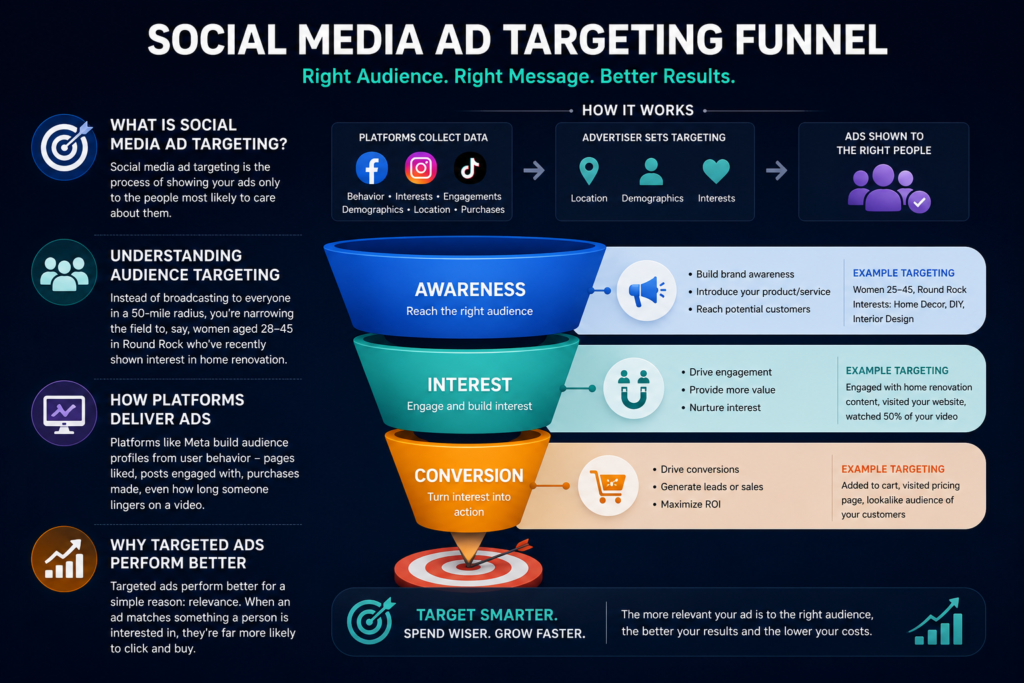
Social media ad targeting is the process of showing your ads only to the people most likely to care about them. Instead of broadcasting to everyone in a 50-mile radius, you’re narrowing the field to, say, women aged 28–45 in Round Rock who’ve recently shown interest in home renovation. That’s the difference between a billboard and a conversation.
How Social Media Platforms Deliver Ads
Platforms like Meta (Facebook and Instagram) build audience profiles from user behavior — pages liked, posts engaged with, purchases made through the platform, even how long someone lingers on a video. Advertisers then layer their own targeting criteria on top of that data to decide who actually sees an ad in their feed or Stories.
Why Targeted Ads Perform Better
Targeted social media ads perform better for a simple reason: relevance. When an ad matches something a person is already interested in, they’re far more likely to stop scrolling, click, and eventually buy. Untargeted ads get ignored — or worse, they annoy people into hiding your page entirely.
Why Effective Social Media Targeting Is Important
Better Engagement
Ads shown to the right audience naturally get more likes, comments, and shares — which then signals to the platform’s algorithm that the content is worth showing to even more relevant people. It compounds.
Higher Conversion Rates
A well-targeted ad campaign can convert at 2–3 times the rate of a broad, “spray and pray” campaign. That’s not a rounding error — that’s the difference between a campaign that pays for itself and one that quietly drains the budget.
Lower Advertising Costs
Meta’s ad auction rewards relevance. The more engagement your ad earns, the lower your cost per click tends to be. Sloppy targeting doesn’t just waste impressions — it actively drives your costs up.
Improved ROI
Put those three together — more engagement, higher conversions, lower costs — and you get the real prize: a stronger return on ad spend. This is the heart of any serious social media advertising strategy, and it’s exactly what determines how to increase ROI with social media advertising over time.
How to Identify Your Ideal Audience
Demographics
Age, gender, income bracket, education level, job title, parental status — these are the basics, and they still matter. A campaign for a luxury remodeling company shouldn’t be targeting the same audience as a campaign for a budget moving service.
Interests
Facebook and Instagram let you target based on pages people follow, topics they engage with, and hobbies they’ve signaled interest in — fitness, home improvement, travel, parenting, small business ownership, and thousands of other categories.
Behaviors
Behavioral targeting looks at what people actually do: recent purchases, device usage, travel patterns, even whether someone recently moved. This tends to be more predictive than interests alone.
Purchase Intent
Some audiences are just browsing. Others are actively comparing options and ready to buy this week. Layering purchase-intent signals — like recent searches or engagement with competitor content — helps you find the second group.
Customer Pain Points
The most overlooked step: talk to your actual customers. Ask what problem they were trying to solve when they found you. That language, almost word for word, should show up in your ad copy and inform your audience segmentation for social media campaigns.
Quick FAQ
Start by defining your ideal customer using demographics, interests, and online behaviors — then refine as real campaign data comes in.
It depends entirely on where your target audience actually spends time. Instagram skews younger and more visual; Facebook still reaches a broad, slightly older, high-intent audience.
Yes — targeted ads are actually one of the most cost-effective ways for small businesses to reach qualified customers without wasting money on broad reach.
Best Audience Targeting Strategies for Social Media
Interest-Based Targeting
Layer two or three specific interests together rather than one broad category. “Yoga” alone is huge and expensive to target; “yoga” plus “organic food” plus “sustainable living” gets you a sharper, more affordable slice of the market.
Behavioral Targeting
Combine interest data with behavioral signals — recent movers, frequent online shoppers, small business owners — to build an audience that’s not just interested, but likely to act.
Geographic Targeting
For local businesses, this is non-negotiable. Radius targeting around a physical location, or targeting by zip code, keeps ad spend focused on people who can actually walk through your door or use your service area.
Custom Audiences
Upload your existing customer list or website visitor data, and Meta will match it to real user accounts. This lets you re-engage past customers or retarget people who almost converted but didn’t finish checkout.
Lookalike Audiences
Once you have a solid custom audience, Meta can build a “lookalike” — a new group of people who share similar characteristics with your best customers. This is often where the highest-performing, lowest-cost campaigns come from.
These five approaches make up the core of most best social media ad targeting strategies for small businesses, and they scale up just as well for larger accounts.
Facebook Ad Targeting Best Practices
Core Audiences
Facebook’s Core Audiences let you manually build a targeting profile from demographics, interests, and behaviors — still the starting point for most campaigns.
Custom Audiences
As mentioned above, custom audiences built from your CRM, email list, or website traffic are consistently some of the highest-converting segments available.
Lookalike Audiences
For Facebook ad targeting specifically, a 1% lookalike (the closest match to your source audience) tends to convert best, while a broader 5–10% lookalike is useful for scaling reach once a campaign is proven.
Advantage+ Audience Features
Meta’s automated Advantage+ targeting uses machine learning to find high-performing audiences beyond your manual settings. It’s not magic, but paired with good creative and a clear offer, it often outperforms manual targeting alone — especially once a campaign has enough conversion data to learn from.
Instagram Ad Targeting Tips
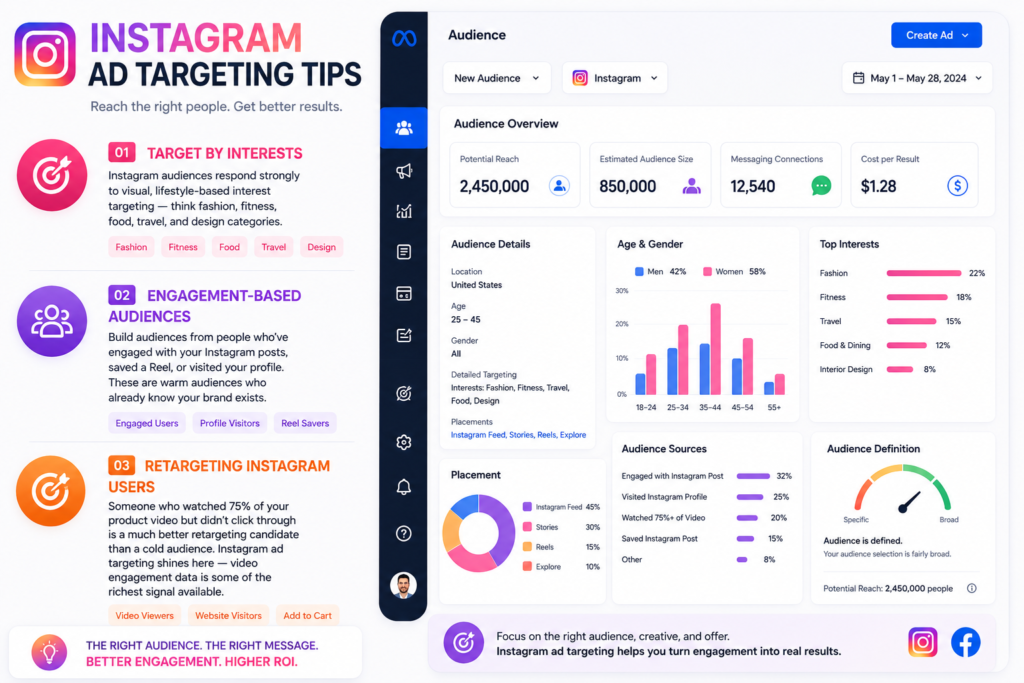
Target by Interests
Instagram audiences respond strongly to visual, lifestyle-based interest targeting — think fashion, fitness, food, travel, and design categories.
Engagement-Based Audiences
Build audiences from people who’ve engaged with your Instagram posts, saved a Reel, or visited your profile. These are warm audiences who already know your brand exists.
Retargeting Instagram Users
Someone who watched 75% of your product video but didn’t click through is a much better retargeting candidate than a cold audience. Instagram ad targeting shines here — video engagement data is some of the richest signal available on the platform.
Creating a Winning Social Media Advertising Strategy
Set Campaign Goals
Awareness, traffic, leads, or sales — each goal changes how the algorithm optimizes delivery. Trying to chase all four at once with one campaign usually means you get none of them well.
Select the Right Platform
Don’t assume you need to be everywhere. A B2B service business might get far more out of Facebook and LinkedIn than Instagram, while a boutique retail brand often sees the opposite.
Match Ads to Buyer Intent
Cold audiences need education and trust-building. Warm, retargeted audiences need a clear reason to act now — a limited-time offer, a testimonial, a direct comparison.
Optimize Creatives
Test at least 3–4 creative variations per audience. Even small changes — a different opening line, a different thumbnail — can shift click-through rate by 30% or more.
A solid social media marketing strategy isn’t a one-time setup. It’s closer to a living document that gets adjusted weekly based on what the data shows.
Common Social Media Ad Targeting Mistakes
Targeting Too Broadly
“Everyone” is not an audience. Broad targeting without enough conversion data behind it usually burns budget fast with little to show for it.
Ignoring Customer Data
Businesses sitting on years of customer purchase history that never gets uploaded as a custom audience are leaving some of the cheapest, highest-converting ad opportunities on the table.
Not Testing Audiences
Running one audience for months without testing alternatives means you never actually learn what’s working versus what’s just… running.
Poor Ad Messaging
Even perfect targeting can’t save a weak or generic message. If the ad doesn’t speak directly to the audience’s specific problem, all that precise targeting goes to waste.
Avoiding these four issues is honestly most of how to improve social media ad targeting without overhauling anything else about paid social media advertising.
How to Improve ROI with Social Media Advertising
A/B Testing
Test one variable at a time — audience, creative, or copy — so you actually know what moved the needle.
Audience Refinement
Revisit your targeting every few weeks. Exclude people who’ve already converted, expand lookalikes once you have enough data, and cut audiences that consistently underperform.
Conversion Tracking
Install the Meta Pixel (or Conversions API) properly. Without accurate tracking, you’re optimizing blind, and the platform’s algorithm can’t learn what a “good” result actually looks like.
Budget Optimization
Shift spend toward what’s working, and don’t be afraid to pause what isn’t — even if it “just needs more time.” Sometimes it does. Often it doesn’t.
Together, these four habits are really the whole playbook behind how to increase ROI with social media advertising, and they apply whether you’re spending $500 a month or $50,000.
Social Media Ads for Small Businesses
Budget-Friendly Campaigns
You don’t need a five-figure monthly budget to see results. A well-targeted $15–20/day campaign, run consistently for a month, will usually outperform a scattershot $100/day campaign run for a week.
Local Targeting
For a business with a physical location or defined service area, geographic and radius targeting stretches every dollar further — you’re only paying to reach people who could realistically become customers.
Scaling Successful Campaigns
Once a campaign proves itself — say, a consistent cost per lead under your target — scale gradually. Doubling budget overnight often resets the algorithm’s learning and temporarily tanks performance.
Social media ads for small business owners work best when they’re treated as an ongoing, tested system rather than a one-off boost button click.
Social Media Advertising Services in Austin, TX
Why Local Businesses Need Professional Campaign Management
Austin’s market is crowded and it’s only gotten more competitive as the city’s population and small business scene have grown over the past several years. Standing out on Facebook and Instagram takes more than boosting a post — it takes structured audience testing, ongoing optimization, and someone watching the numbers weekly, not once a quarter.
Choosing the Right Advertising Partner
At Flash Digital, based right here in Austin, TX, we build campaigns around real audience data rather than guesswork — combining local market knowledge with platform-level targeting tools like custom audiences, lookalikes, and geo-targeting to reach the customers who are actually searching for what a business offers. If you’ve been searching for social media advertising services in Austin TX, or simply typed “social media ad management near me” into Google late one night trying to figure out why your last campaign flopped, that’s exactly the gap we work to close.
Benefits of Local Expertise
A team that understands Austin’s neighborhoods, seasonal patterns, and local competition can build sharper geographic and interest-based targeting than a generic, out-of-state agency running the same playbook for every city. Flash Digital works with small and mid-sized businesses across the Austin area to build social media ad targeting tips for local businesses into every campaign from day one, not as an afterthought.
Quick FAQ
In most cases, yes — running campaigns across both platforms usually expands reach and improves overall performance, since Meta’s algorithm can shift budget toward whichever placement is converting best.
Review performance every 2–4 weeks and adjust based on what the data shows, rather than waiting for a campaign to visibly fail.
Generally, yes — retargeting usually delivers higher conversion rates because it’s reaching people who already know your brand.
Measuring the Success of Social Media Ads
Reach
How many unique people saw your ad. Useful for awareness campaigns, less meaningful on its own for sales-focused ones.
Click-Through Rate (CTR)
The percentage of people who clicked after seeing your ad. A healthy CTR for most Facebook and Instagram campaigns lands somewhere between 1–2%, though it varies a lot by industry.
Cost Per Click (CPC)
What you’re paying, on average, for each click. Lower isn’t always better if the traffic doesn’t convert — but it’s a useful early signal of targeting efficiency.
Return on Ad Spend (ROAS)
For every dollar spent, how many dollars came back in revenue. A 3:1 ROAS is often considered solid for e-commerce; service businesses tend to measure this differently based on customer lifetime value.
Conversion Rate
The percentage of clicks that turned into an actual lead or sale. This is where good targeting really shows up — the same ad spend, aimed at the right audience, can double or triple conversion rate without any change to the creative.
Suggested image: Social Media Ads Analytics Dashboard Showing CTR, CPC, ROAS, and Conversions
Build Smarter Social Media Campaigns That Reach the Right Audience
If there’s one takeaway from all of this, it’s that how do I target ads effectively on social media isn’t really a creative question — it’s a data question. The businesses winning on Facebook and Instagram right now aren’t necessarily the ones with the biggest budgets or the flashiest videos. They’re the ones who know exactly who they’re talking to.
Start with a clear picture of your ideal customer. Build out custom and lookalike audiences from real data. Test relentlessly instead of setting and forgetting. And track the numbers that actually tell you whether a campaign is working — CTR, CPC, ROAS, conversion rate — not just likes and shares.
A strong social media advertising strategy blends all of this: sharp audience targeting, platform-specific best practices for Facebook and Instagram, honest measurement, and a willingness to keep refining. Do that consistently, and the ROI conversation tends to take care of itself.
And if building and managing all of that in-house feels like more than your team has bandwidth for, that’s exactly the kind of work Flash Digital handles for businesses across Austin, TX every day.
Related Questions
- What are social media ads?
- How do Facebook Ads work?
- What is audience segmentation in digital marketing?
- How much do social media ads cost?
- What are the latest social media advertising trends in 2026?
- Should you hire a social media advertising agency?
- Why are targeted social media ads more effective?
- What metrics should you track in paid social campaigns?