
Adaptive Software Development
Adaptive Software Development: A Complete Guide to Building Flexible Software Solutions
Why Modern Software Projects Need Adaptability
Picture this: a mid-sized fintech company kicks off a nine-month software build. Three months in, a new compliance regulation drops. The original spec is suddenly half-obsolete. Under a rigid, plan-everything-up-front model, that’s a crisis. Under a flexible one, it’s just Tuesday.
That’s the real case for adaptive software development. Business requirements don’t hold still anymore — customer expectations shift, markets shift, regulations shift — and software built to survive only one version of the future tends to break the moment reality veers off script. Traditional development models, the ones that lock in every requirement before a single line of code gets written, weren’t built for that kind of movement.
What You’ll Learn in This Guide
This guide breaks down what Adaptive Software Development (ASD) actually is, where it came from, and how it plays out in practice — from the core Speculate-Collaborate-Learn cycle to real differences between ASD and standard Agile. We’ll also get into the benefits for businesses, where it shines in enterprise settings, common pitfalls, and how to pick the right adaptive software development company when you’re ready to build. If you’re comparing an adaptive software development methodology against whatever your team is currently doing, this should give you a clear, practical answer either way.
What Is Adaptive Software Development?
Definition of Adaptive Software Development
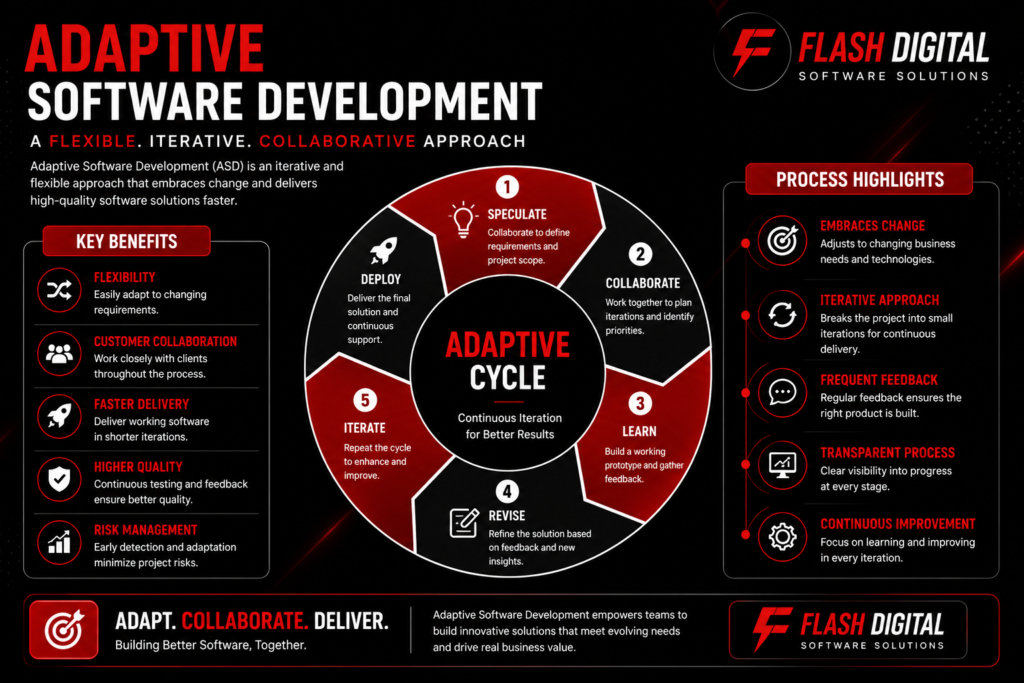
So, what is adaptive software development, exactly? At its core, it’s a software development approach built around the assumption that you can’t fully predict a project’s requirements at the start — so instead of trying, teams work in short, tight cycles of building, testing, and adjusting based on what they actually learn along the way.
History and Evolution of the ASD Model
The adaptive development model was formalized by Jim Highsmith in the late 1990s, growing out of the same rapid-application-development roots that later fed into the broader Agile movement. Where a lot of methodologies focus on process discipline, ASD leaned harder into a different question: how do teams keep learning and adjusting once a project is already underway, not just before it starts?
Why Businesses Choose Adaptive Development
Businesses land on ASD when they know, going in, that requirements are going to move — a healthcare startup waiting on FDA guidance, a retailer building for a shopping season that hasn’t happened yet, a SaaS company iterating against live user data. In those cases, an adaptive software development methodology isn’t a nice-to-have. It’s the only approach that actually matches how the project will unfold.
Core Principles of Adaptive Software Development
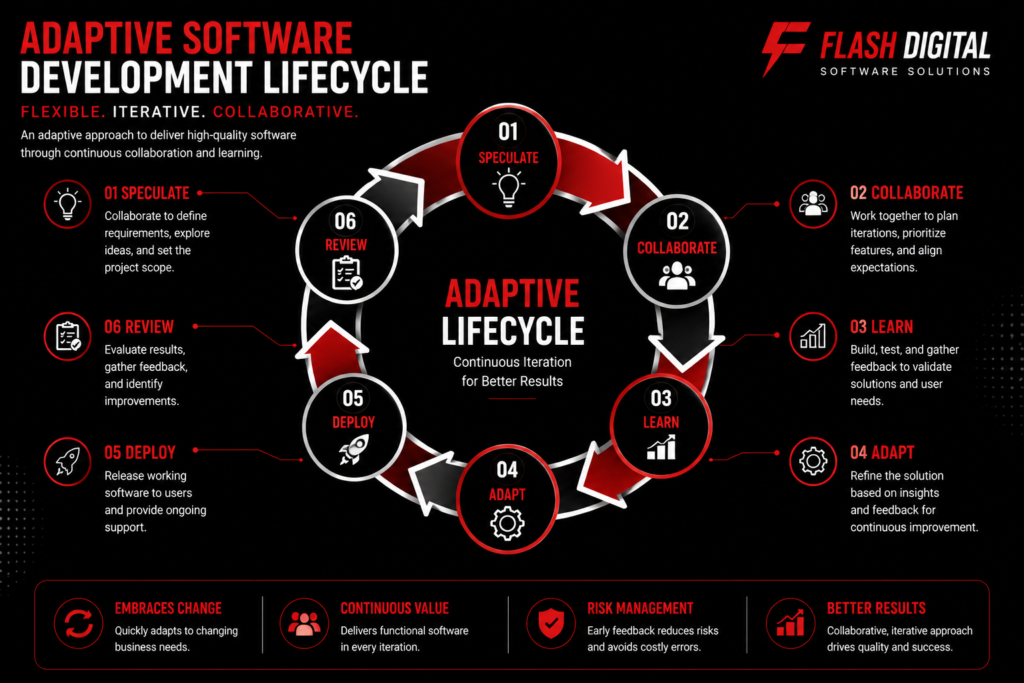
Speculate
Rather than “plan,” ASD uses the word “speculate” on purpose. Teams sketch out a mission and rough project outline, while openly acknowledging that some of it will be wrong. That mindset alone changes how a team reacts when reality contradicts the plan.
Collaborate
Adaptive project management leans hard on close, constant collaboration — between developers, stakeholders, and end users — rather than handing off a finished spec and disappearing until launch day.
Learn
After each cycle, the team formally reviews what worked, what didn’t, and what they got wrong about the requirements. This “learn” phase is where ASD earns its name; the whole adaptive software development process is built to absorb new information and act on it immediately, not file it away for the next project.
Continuous Feedback
Customer-driven development means the people who’ll actually use the software are looped in throughout the build, not just at kickoff and delivery. That steady feedback loop is often what separates real software innovation from a team that just guessed well once.
How the Adaptive Software Development Process Works
Planning and Requirement Discovery
It starts with a mission statement and a rough project outline — enough structure to get moving, not so much that the team is locked in before they’ve learned anything.
Iterative Development
Work happens in short cycles, often two to four weeks, each one producing something real and testable rather than a stack of documentation. This is iterative software development in its purest form: build a slice, check it against reality, adjust.
Continuous Testing
Testing isn’t a phase tacked on at the end — it runs alongside development in every cycle, catching issues while they’re still cheap to fix instead of six months later when they’re baked into everything downstream.
Customer Feedback and Improvement
At the close of each cycle, real users or stakeholders interact with what’s been built. Their feedback directly shapes the next cycle’s priorities — this is incremental software development with an actual feedback loop attached, not just smaller batches of the same rigid plan.
Deployment and Continuous Delivery
Rather than one big-bang launch, features roll out incrementally through continuous software delivery, so the business starts getting value — and real usage data — well before the “final” version exists.
Quick FAQ
It’s a flexible software development approach that evolves through continuous collaboration and feedback rather than a fixed, upfront plan.
Not exactly — ASD is Agile-inspired, but it puts more explicit weight on the learning and adaptation cycle than most standard Agile frameworks do.
It works best for projects where requirements are likely to shift — new regulations, evolving customer needs, or markets that move faster than a six-month spec can keep up with.
Adaptive Software Development vs. Agile Methodology
Similarities Between ASD and Agile
Both prioritize short cycles, working software over exhaustive documentation, and close collaboration with stakeholders. If you’ve worked in agile software development before, ASD will feel immediately familiar.
Key Differences
Agile development, especially frameworks like Scrum, tends to structure work around fixed-length sprints with defined ceremonies. ASD is looser by design — its Speculate-Collaborate-Learn cycle centers explicitly on adapting to uncertainty, rather than optimizing a repeatable sprint cadence.
Adaptive Software Development (ASD) focuses on learning, collaboration, and adapting to uncertainty throughout the software development process. Instead of relying on rigid plans, ASD encourages teams to “speculate” by creating provisional plans that can evolve as new information becomes available. This approach is particularly effective for projects with high uncertainty, changing requirements, or unclear business goals. Its flexible, cycle-based structure allows teams to continuously learn from feedback, refine their solutions, and respond quickly to changing customer needs.
In contrast, Agile/Scrum emphasizes iterative delivery through fixed-length sprints with clearly defined backlogs and planned work. It is best suited for well-scoped projects where requirements and roadmaps are relatively stable. Scrum follows a structured framework with regular ceremonies such as sprint planning, daily stand-ups, sprint reviews, and retrospectives to ensure consistent progress and team collaboration. While both ASD and Agile promote iterative development and teamwork, ASD offers greater flexibility for unpredictable environments, whereas Scrum provides a more structured process for delivering software in manageable increments.
Benefits of Adaptive Software Development for Businesses
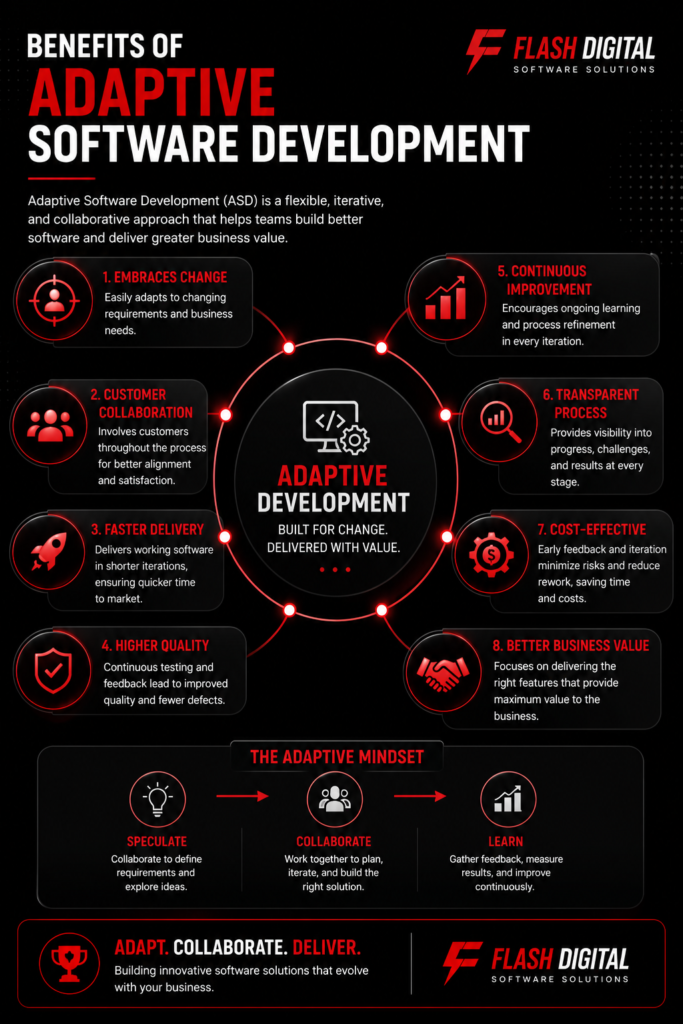
Faster Response to Change
When a competitor launches a feature overnight or a regulation changes mid-project, teams running ASD can pivot within a cycle or two instead of restarting a six-month plan from scratch.
Better Collaboration
Constant touchpoints between developers and stakeholders mean fewer surprises at delivery — and far fewer “that’s not what we asked for” conversations.
Higher Software Quality
Continuous testing and real user feedback, cycle after cycle, is a big part of how adaptive software development improves software quality — problems surface early, while they’re still small and cheap to fix.
Reduced Project Risks
Short cycles mean a bad assumption gets caught in week three, not month nine, drastically shrinking the blast radius of any single mistake.
Faster Time to Market
Because features ship incrementally, the business often starts generating value — and real user data — months before a traditionally-run project would even reach its first release.
Together, these add up to genuinely scalable software solutions that grow and adjust alongside the business, instead of needing a costly rebuild every time priorities shift.
Common Challenges in Adaptive Software Development
Changing Requirements
Ironically, the same flexibility that makes ASD powerful can also cause scope drift if it isn’t actively managed — someone needs to own prioritization every cycle, or “adaptive” quietly turns into “unfocused.”
Team Collaboration
ASD asks a lot from teams in terms of constant, honest communication. Teams used to working in silos sometimes need real process changes, not just a new project label, to make it work.
Communication Gaps
Fast cycles move quickly, and a missed handoff or unclear feedback loop can compound over several iterations if nobody’s watching for it.
Managing Stakeholder Expectations
Stakeholders used to a fixed roadmap sometimes struggle with “we’ll know more after this cycle.” Good adaptive project management means setting that expectation clearly on day one, not explaining it after the fact.
Quick FAQ
Yes, particularly when requirements are expected to keep evolving — which, realistically, most long-term projects do.
Absolutely. ASD scales down just as well as it scales up, working for a five-person startup team as readily as a 200-person enterprise org.
Yes — continuous feedback surfaces issues early, well before they’ve had a chance to compound into something expensive.
Best Practices for Adaptive Software Development
Continuous Customer Feedback
Build real feedback checkpoints into every cycle — not a single survey at the end, but ongoing conversations with the people actually using the product.
Frequent Releases
Smaller, more frequent releases reduce risk and give the team a constant stream of real-world data to adjust against.
Cross-Functional Teams
Mixing developers, designers, QA, and product folks into one team — rather than separate departments handing work down a chain — cuts down on the communication gaps that slow adaptive projects down.
Automation and DevOps
DevOps integration, especially automated testing and CI/CD pipelines, is what makes fast, frequent cycles sustainable instead of exhausting. Without it, “ship every two weeks” quickly turns into “ship every two weeks, badly.”
Regular Performance Reviews
Beyond the ASD-specific “learn” phase, regular technical and process reviews — borrowing structure from the Scrum framework or Kanban methodology where useful — help keep quality and velocity from drifting apart.
Why Adaptive Software Development Matters Today
Faster Market Changes
Markets shift in months, sometimes weeks, not years. Software product development that assumes a stable set of requirements for a year-long build is increasingly a gamble.
Customer Expectations
Users expect products to keep improving in near real time. A process that only ships once or twice a year struggles to keep pace with that expectation.
Competitive Advantage
Teams that can adapt mid-project — without blowing up the budget or timeline — simply out-execute the ones locked into a fixed plan.
Innovation Through Flexibility
Good software engineering isn’t just about writing clean code; it’s about building a process that lets a team actually respond to what they learn. That’s where real software solutions distinguish themselves from ones that technically work but never really fit the problem.
Choosing the Right Adaptive Software Development Company
Experience and Technical Expertise
Look for a team that can point to real, completed projects — not just a portfolio of logos, but specifics about what changed mid-build and how they handled it.
Development Methodology
Ask directly how they run cycles, how often stakeholders are looped in, and how feedback actually gets turned into next-cycle priorities. Vague answers here are a red flag.
Communication and Transparency
A good adaptive software development company should make it easy to see what’s being built, tested, and shipped at any point — not just at a big quarterly review.
Long-Term Support
Adaptive software development services shouldn’t stop at launch. Ongoing support, monitoring, and iteration are part of the same philosophy that got the product built in the first place — custom software development doesn’t really end at deployment.
Adaptive Software Development Services in New York City
Why NYC Businesses Need Adaptive Solutions
New York’s business environment moves fast — fintech startups competing against established banks, retail brands adjusting to shifting foot traffic across boroughs, healthcare and legal firms navigating regulation that can change with little warning. A software build that can’t flex with that pace becomes outdated before it even ships.
Benefits of Working with a Local Development Partner
A development partner based in the city understands New York’s business rhythms, its client expectations, and the kind of scale — from a five-person startup in Brooklyn to an enterprise team in Midtown — that local companies actually operate at. That local context tends to shorten the learning curve considerably compared to an outsourced, out-of-state team working from a generic playbook.
How Flash Digital Builds Scalable Software Solutions
Flash Digital, based in New York City, builds software using the same Speculate-Collaborate-Learn rhythm this guide has walked through — short cycles, constant stakeholder input, and testing baked into every stage rather than bolted on at the end. For businesses searching for adaptive software development services in New York City, or simply typing “software development company near me” into Google after a rigid build has gone sideways, that’s the gap Flash Digital works to close: a custom adaptive software development company in NYC that treats changing requirements as normal, not as a crisis to manage around.
Building Future-Ready Software with Adaptive Development
Software that can’t bend tends to break — not immediately, but eventually, usually right when the business needs it most. Adaptive software development gives teams a real structure for building things that can absorb change instead of fighting it: shorter cycles, constant feedback, and a process built around learning rather than guessing correctly once at the start.
The payoff shows up in faster delivery, stronger collaboration between technical and business teams, and software quality that holds up because it’s been tested against reality all along the way — not just at the end. For enterprise teams juggling scale and complexity, that same flexibility becomes what makes growth manageable instead of chaotic.
None of that happens automatically, though. It depends heavily on choosing the right adaptive software development company — one with real experience running these cycles, not just the vocabulary. Whether that’s a specialized adaptive software development services provider or an in-house team learning the model for the first time, the goal is the same: software built to keep working as the business around it keeps changing.
Future Internal Linking Questions
- How does adaptive software development work?
- What is iterative software development?
- What is incremental software development?
- How does DevOps support adaptive software development?
- What industries benefit most from adaptive software development?
- How does cloud application development fit into adaptive software development?
- What are the latest software development trends in 2026?
- How do Scrum and Kanban support adaptive software development?